Review
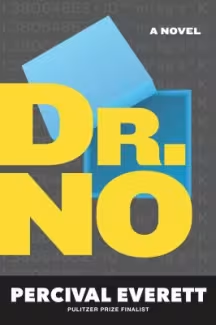
Dr. No : a novel
Review
If you are a fan of Percival Everett, his most recent novel is for you. If you love satire then this novel is for you. It is satire on fire, by way of Everett’s genius and ingenuity to riff on various subjects: the competitive, snooty know-it-all attitude among professionals who work in subject areas and subdivisions of physics, mathematics, philosophy, and in public and private agencies. Add to this a narrative that is rich with double entendres and quadruple entendres about names, words, sentences, ideas, complex theories and novels. Percival Everett plays this like a master jazz musician, presenting themes and interweaving others, so that one reading is tantalizingly not enough.
The novel is told from the perspective of mathematics Professor Wala Kitu, if indeed that is his real name. In Tagalog, Wala means nothing and in Swahili, Kitu means nothing. Professor Kitu’s expertise is in the study of nothing, and this attracts the attention of a man, John Milton Bradley Sill, who wants to become a super villain by robbing Fort Knox, not for its gold, but for a box that has nothing in it. To help Sill do the job, Kitu is presented with a check for three million dollars, which causes a problem when the professor goes to his neighborhood bank to depost the check. Kitu is definitely brilliant, however he is an innocent, like Voltaire’s Candide, and reacts to comments in the most disarmingly literal manner, which might indicate he is on the autistic spectrum, or that he just likes to lead people on, readers included.
There is no mistake that the novel, in title and content, references Ian Fleming’s novel, Dr. No. In Everett's novel there is a scene, that is a parody of one in Fleming's novel and in the movie, of the horrific laboratory where James Bond is about to be tortured and killed. The spy-counterspy theme is another layered theme woven into the fusion in this work.
When reading this novel, other writers and their works came to mind: Jonathan Swift’s A modest proposal; Mikhail Bulgakov’s Master and Margarita; the novels of Tobias Smollett; Miguel de Cervantes’ Don Quixote; Voltaire’s Candide; the works of Kurt Vonnegut and Mark Twain. Percival Everett’s work is among those great writers, and many others, who have brilliantly shaken up what is unjust, unfair and often damaging to everyone.
This review minimally covers the complexity, humor and delight this novel offers up. It is not necessary to get or understand all of the allusions. I have not. There is a little list of scientists and theories that I want to research. The novel can be read as romp, with Everett skillfully poking holes in enough ordinary ways of living and thinking to delight, maybe shock, but unequivocallly make all of us snap to, and think in ways we never would have.