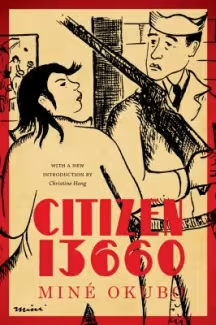
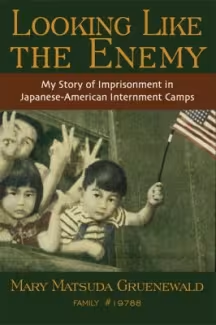
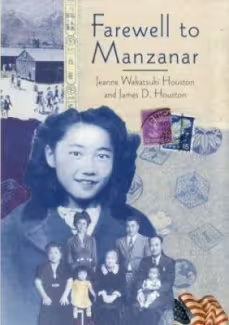
Memoirs of Japanese-Americans Incarcerated During World War II


By the late nineteenth century, the West Coast of the United States was home to thriving Japanese communities. After the Chinese Exclusion Act of 1882 barred the immigration of Chinese workers, Japanese laborers were sought for many industries, including agriculture and fishing. By the early 1900s, numerous Japanese women had come to the United States to join their husbands and start families. Locally, two Japanese communities thrived: Little Tokyo, near downtown Los Angeles, and the fishing community on Terminal Island, known as Fish Harbor. Rafu Shimpo, the oldest Japanese language newspaper in the United States, began publishing in 1903. Temples and churches were built, and a Japanese American Chamber of Commerce was established.
Everything changed for Japanese Americans on December 7, 1941, when Japanese aircraft attacked the American naval base at Pearl Harbor. Japanese Americans quickly fell under suspicion, regarded as spies or saboteurs. Their loyalty was questioned, regardless of citizenship. On February 19, 1942, Franklin Roosevelt signed Executive Order 9066, which ordered the removal and incarceration of West Coast residents of Japanese descent.
A civilian organization called the War Relocation Authority quickly established a network of Assembly Centers and Relocation Centers. Families were given six days to put their belongings in storage and report to an assembly center, bringing only what they could carry. Assembly centers were often on racetracks or fairgrounds. Families would live in converted horse stalls or in fairground halls.
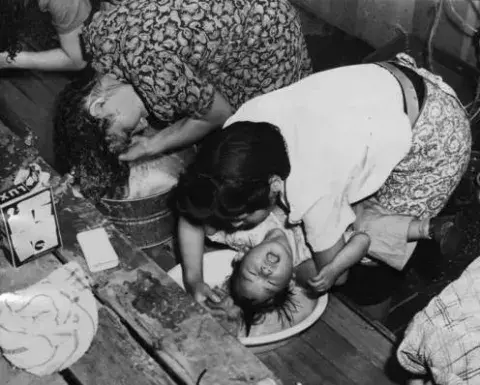
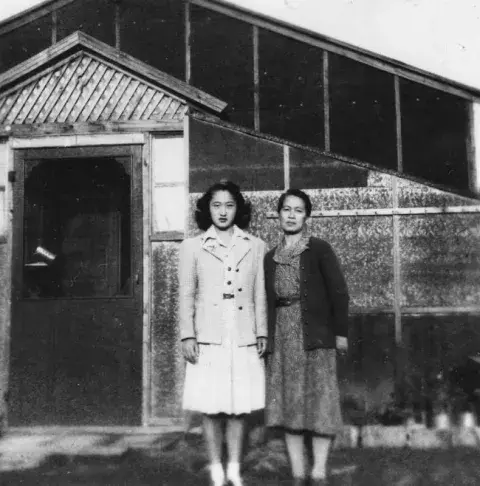
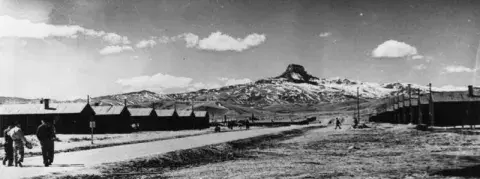
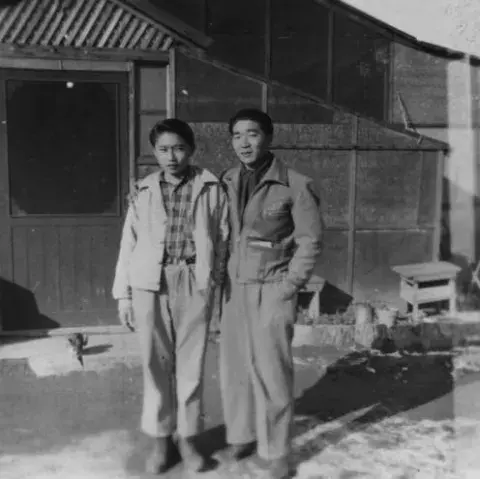
Families would eventually be assigned to a relocation center, where they lived for several years. These were effectively prison camps where families would share barracks. Kitchens and latrines were communal. Relocation centers were also like small towns, with post offices, schools, and worksites for adults. Often there was space for livestock and crops. These camps tended to be in isolated, barren areas with freezing winters and hot summers. The prison camps were surrounded by barbed wire and watched over by guards in towers. One of the most famous relocation centers is Manzanar, about 200 miles north of Los Angeles. Today, it is a historic site managed by the National Park Service.
Over 100,000 Japanese Americans, most of them American citizens were sent to relocation centers far from home, where they were forced to live in difficult, uncomfortable conditions. Family pets had to be left behind. Numerous children spent several of their formative years in camps surrounded by barbed wire. Families lost their homes, their businesses, and most of their belongings. The last of the relocation centers did not close until March 1946.
Following the evacuation of the Japanese, the Los Angeles neighborhood of Little Tokyo was empty. African Americans began moving into Little Tokyo, trying to avoid segregation laws that restricted where they could live and establish businesses. Little Tokyo became known as Bronzeville. New businesses included jazz clubs, bars, and restaurants. After the war, African Americans moved out and, over time, Little Tokyo thrived again as a vibrant Japanese community.
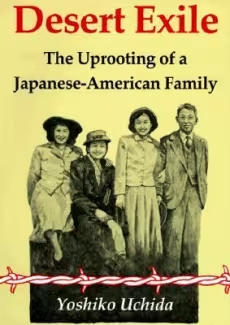
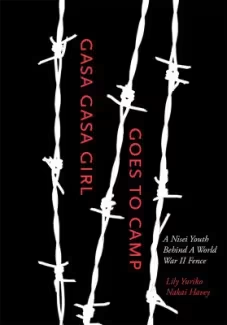
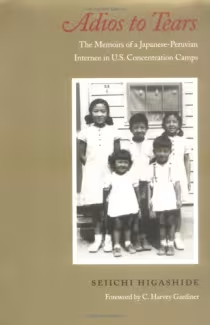
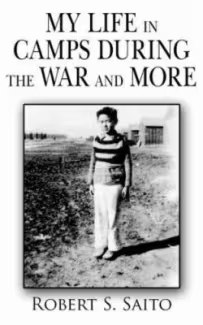
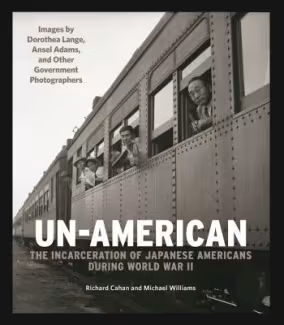
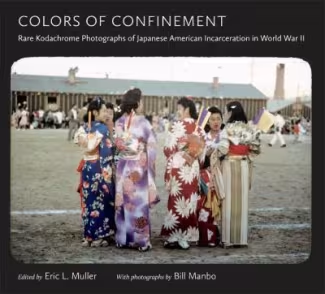
It is essential that we continue to remember the experience of Japanese Americans during World War II. Sadly, very few people who lived through this ordeal are still alive to tell their stories. The Little Tokyo Historical Society and the Japanese American National Museum are two local institutions that preserve and honor the Japanese American experience of World War II. The History Department at the Los Angeles Public Library Central Library has an extensive collection of books about the Japanese American Internment, including personal memoirs and pictorial works. The following titles are representative of the History Department’s broad and evolving collection.