Review
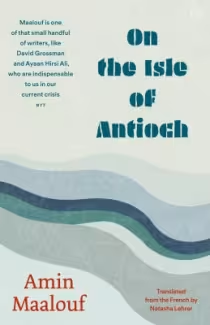
On the Isle of Antioch
Review
The novel is divided into four chapters: First notebook: Fog; Second notebook: Patches of Sunlight; Third notebook: Moorings; Fourth notebook: Disappearance. It covers one month, beginning on November 9 and ending on December 9, with no year specified, but is definitely in the present.
Graphic artist Alexandre, aka Alec, has chosen to live alone and work on the island of Antioch, somewhere off the French Atlantic coast. He depends on having consistent electricity for the internet, cell phone service, and radio communication. When electricity ceases with the whining noise coming from his radio, this sets off a series of events that will involve others: a writer Eve, the other inhabitant of the island; people who live on adjacent small nearby islands; friends of Alec who have connections with major world leaders; and a mysterious group of people known as the Friends of Empedocles, whose origins are never known.
The novel has been classified as either speculative fiction or dystopian fiction. The novel is speculative fiction with dystopian elements but concludes cautiously hopeful. That is if humanity will take seriously what could have happened, all of which was dependent on the proactive communication and planning of others. At one point, Alec states what could happen, "Not a natural disaster, but a violent apocalypse shaped by human hands. The ultimate blow to our species. Bringing to an end thousands of years of history."
On the Isle of Antioch is part of the great tradition of modern speculative fiction that utilizes the novel as a means to create a cautionary tale about the foibles of humanity and the resulting disasters that could take place. Think of Albert Camus’ The Plague; Aldous Huxley’s Brave New World; George Orwell’s 1984; and Nevil Shute’s On the Beach. That being said, Amin Maalouf has created a far more nuanced and beautiful novel, both in language and in plot. Read it as an adventure story or read it as a warning, either way Maalouf gives us a great deal to ponder. He has enriched and ennobled the novel with historical and literary symbols and allusions to ancient history and historical figures, mythology, geographical names, and the Bible, Old and New Testaments.
Alec cautions us, “I have not read or tidied up my words in any way.” Take this as an inside joke by Amin Maalouf, after all he is the one in charge, having written the novel and done all the tidying up.