Review
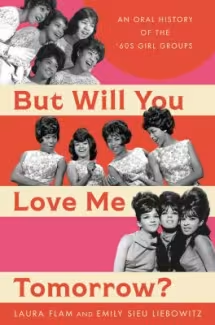
But will you love me tomorrow? : an oral history of the '60s girl groups
Review
You know the melodies, the tunes, the lyrics, the remixes because you have heard them, and you do hear them everywhere: the radio, piped-in in stores, online, e-media, movies … Sometimes it’s just the music, sometimes it's the music and the lyrics. There is a certain brightness, rhythm, saucy innuendo in the lyrics or titles, and often some irreverence in the vocal interpretation by those female singers, all in harmony, singing those unforgettable songs. The book's title is the title of a song, "But will you love me tomorrow?" which was controversial in its day, 1961, because it raised all kinds of questions about what a girl and boy were doing that night, and would the girl get some respect the next day.
It was a pop genre that became known as “the girl group” that existed from the mid-1950s to the mid-1960s. That era was on the cusp of social, sexual and political upheaval, and the lyrics and singers reflected what was about to drastically change. At the time, the term “girls” was not pejorative because some of the singers were as young as 12 years old, and it was a sign of the times to refer to women as girls. The singers were not known necessarily as individuals, but as part of a group, wherein other girl singers could easily replace those in the group. As now, there were many wannabes. The accolades and individual recognitions went to the songwriters and producers.
Laura Flam and Emily Sieu Liebowitz have compiled over 100 oral interviews which they did between 2019 and 2022, with individual singers, songwriters, agents, managers and others. Their coverage was selective, but for "an incredible and meticulous listing of groups of the era," they recommend Girls Groups: fabulous females who rocked the world. Their book begins with the heyday of the girl groups, then works through the later 1960s, the 1970s and up to the present because the genre was far reaching in its influence. There is nostalgia in remembering the songs, but there is reality as to what it was like to be part of what could be a back-up group but was more often than not, a featured singing group. And, in their remembrances many of the singers talk about encounters with other singers and musicians, who at the time, were in their own early stages of becoming well known. There are anecdotes about competition, backstage antics, temper tantrums, verbal and physical fights, money for performances and promised money for future trust funds, arguments about musical arrangements, clothes, hair and make-up. The authors include numerous pages of black and white photographs (many appear to be carefully staged PR snaps), a lengthy bibliography and a rich index. All of this might make you want to hear all of those songs again, in their original versions from those original girls, and maybe just get up and dance.
A poignant, timely reminder was the reported death, last Friday, of Mary Weiss, who was 75 years old. In her recordings with the girl group, the Shangri-Las, she will live on, forever young and rebellious, with one of their songs, “The Leader of the Pack,” that was the top Billboard single of 1965.