
History of Cahuenga Branch Library
The Beginnings
In 1900, Hollywood was a farming village of 500. Oranges, avocados, bananas, and wheat grew on the site of of Los Angeles City College, and north toward the present Los Feliz area.
By 1910, the population had grown to 7,000, and Hollywood and East Hollywood were being annexed to Los Angeles. The area was served by the Red Car Line, and the fare from Los Angeles was five cents. With cityhood, demand for services arose. The Los Angeles Normal School, a teacher training institution, was built; in 1919 it became the University of California, Southern Branch, and in 1929, when UCLA was built, it changed to Los Angeles Junior College, now City College. The Children’s Hospital was begun, and a group of citizens offered to purchase land for a Neighborhood library near Santa Monica and Vermont.
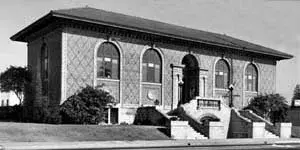
The building was funded by the steel magnate Andrew Carnegie; the total cost, including equipment and furniture, was $33,978. The location, Santa Monica and Madison, was selected by the Library Board under the chairmanship of Mr. Orra E. Monette, because it was less expensive than the corner of Santa Monica and Vermont. Eventually, the site was acquired through assessment proceedings, and a substantial, dignified brick-faced building was constructed in the Italian Renaissance style.
The architect was Clarence H. Russell (1874-1942), who was also associated with Norman F. Marsh in the building of Venice and its canals.
The floor plan of the library was known as the “butterfly” type, containing two reading rooms, one on each side of a central entrance, a desk, and a stack room. The building contained 8,474 square feet of floor space on two floors. Besides the children’s and adult reading rooms, there were an auditorium, a room for children’s story hours, a staff room, and even an open-air reading room.
The library's name was selected for its historical significance. "Cahuenga" is a Spanishized version of the Tongva word, "Kawee'nga," which loosely translates to "place of the hill" or "place of the fox," according to local Indigenous scholars. Originally, "Kawee'nga" referred to a Tongva settlement in the San Fernando Valley. Over time, the name "Cahuenga" has found use in various parts of the City of Los Angeles, including Cahuenga Boulevard. The Los Angeles Public Library recognizes that we occupy land originally and still inhabited and cared for by the Tongva, Tataviam, Serrano, Kizh, and Chumash Peoples.
The new library was opened on a cold, rainy Monday, December 4, 1916. In his address, the city librarian Everett Perry, proudly pointed out the modern features: books on open shelves accessible to all; “several thousand carefully selected volumes of children’s literature,” an auditorium “free to the people for meetings, subject to the very liberal regulations of the Library Board.”
The original staff members were Fannie Dorman, branch librarian; Corrie Ziegler, librarian; Gladys Glenn, children’s librarian; Ralph Shaw, page; and George Champion, janitor. Library hours were from 9 a.m. to 9 p.m., Mondays through Saturdays, and 2-6 p.m. on Sundays, until 1922, when all libraries were closed on Sundays.
In 1917, a neighborhood survey was taken. The population was mostly white and blue-collar Anglo; of 2,017 families surveyed, only 58 were immigrants or non-white (Black and Japanese). The area was residential, with single-family homes predominating. Commercial activities were limited to small neighborhood businesses. However, the growing movie industry was present; the Fine Art Studios, where, among other films, Intolerance was made, occupied the site of the present Safeway Market at Virgil and Sunset; Kalem Co. and Mabel Normand Studios were on Hyperion near Fountain, and the William Fox Studio on Sunset and Western Avenue.
The Twenties and Thirties
In 1919 and 1920, the great American architect Frank Lloyd Wright designed Hollyhock House on top of Olive Hill, as it was then called, owned by Mrs. Aline Barnsdall. Mrs. Barnsdall, a wealthy philanthropist and early advocate of women’s rights, wished to further the arts and later sold the entire property to the City of Los Angeles. This is now known as Barnsdall Park and houses the Municipal Art Gallery and the Junior Arts Center.
From the outset, Cahuenga Library was dedicated to community service. “I remember when they were rolling bandages in the Library auditorium during World War I,” says Mr. Raymond Thompson, a resident of the community since 1910, “and they used to have community sings every week.” Over 100 people attended regularly until the influenza epidemic of 1918/9.
Educational programs for adults and children, music, and lectures were all part of the library's resources. The year 1925 offered the following events: Oral Arts Club, weekly; Hollywood Repertoire Company rehearsals three times a week; Americanization classes, three times a week; Boy Scout troop, weekly; Western Rangers, boys’ and girls’ groups, weekly; music recitals; election board for city elections; and post office for handling Christmas mail.
In 1925, the annual circulation of books was 160,153, with a book stock of 11,406. Miss Helen Cummings, a retired teacher and area resident since 1915, and whose father was one of the early farmers of the East Hollywood area, remembers especially the literary lectures and the child health programs given by Dr. Maude Wilde. “As a teacher, I was most interested in the literary and cultural programs of the library. I recall Miss Fannie Dorman, the first branch librarian, and the zeal with which she arranged interesting events.”
Throughout the 1920’s, the neighborhood became more built up. New residents included a community of White Russians, who had come to America to escape the Russian Revolution, as well as Armenian refugees from Russia and Turkey. Both ethnic groups are still apparent today and form an active part of the library’s readership.
Then came the thirties and the Depression, which brought more people to the library than ever before or since. By 1933, the Cahuenga Library had an annual circulation of 373,317. People who lost their jobs had more time to read; they studied to prepare new careers, or found the library just a place to go. More library staff and space were needed to serve readers, and the active community programs became victims of the recession, not resumed until 1971.
The 1930’s also saw phenomenal building activity. Silver Lake Reservoir was completed, and around it arose one of the finest residential neighborhoods in Los Angeles. World-famous architects, such as Richard Neutra, R. M. Schindler, Ralph Soriano, and Gregory Ain, built houses admired to this day for their beauty and advanced design.
The Forties and Fifties
The 1940’s brought World War II and the post-war era. During the war, part of the library building was used for civil defense. The Cahuenga Library was severely affected by population and employment changes. The branch librarian, Mrs. Anna-Marie Hook, gave the following reasons for the decline in circulation from 283,000 to 180,000 during the war years: enlistment and the draft, affecting L.A. City College enrollment, evacuation of Japanese residents, continued employment growth, and nightly blackouts.
The ethnic grouping at that time was described as “the average American people, living in modestly comfortable homes, and while not watching their pennies too carefully…” Some black families, living nearby, were also library users.
The Hollywood Freeway was built from 1947 to 1949 and significantly affected the area served by the Cahuenga Library. Many dwellings were razed, and the inhabitants had to relocate to other areas. The Dayton Heights School is one of those served by the library. lost a larger percentage of students than any other.
The 1950’s brought new construction and renewal. New hospitals were built and old ones refurbished; L.A. City College initiated an eight-year building program. A few new apartments were built, but hardly any new single homes.
The library stayed on an even keel until 1957, when the so-called “student explosion” occurred. After the Russians launched Sputnik, their first space satellite, a tremendous drive for education and learning swept schools and libraries. Cahuenga, too, had to make a great effort to meet the student demand resulting from American zeal to catch up with the Russians. This occurred in 1961.
The Sixties and Seventies
In the 1960’s, more rapid changes began to occur in the neighborhood's composition. The transience rate increased. As the Anglo population gradually moved to the suburbs, they were replaced by Asian, Spanish-speaking, and black residents.
The library initially found it difficult to meet the needs of new patrons, but over time, materials on citizenship, do-it-yourself projects, and languages other than English became available.
The building of the shopping center below Barnsdall Park and the expansion of the one at Vermont and Santa Monica formed a nucleus of activity. However, they had little direct influence on the library; Cahuenga was used because the patrons felt a need for it, not just because it was there.
The 1970 census revealed that 53.3 percent of area residents were either foreign-born or had at least one foreign-born parent. More than 25 percent spoke Spanish as their native language; more than 20 percent were Asians: Japanese, Chinese, Filipinos, Koreans, and Thai. There was a stable Arab population, as well as natives of Russia, France, Greece, Hungary, and Poland. The black population comprised about 5 percent and centered around the area directly adjacent to the library.
Since then, there has been a significant increase in the Asian population, especially the Korean and Filipino populations. New immigrants from Russia, mainly Armenian and Jewish, are also evident. The Arab population has increased, while Armenians from Arabic-speaking countries are on the rise.
In the early 1970’s, the library began to change its image. To be more useful to the neighborhood, it began an outreach program. Ethnic factors were taken into account, and the area's character as a melting pot was recognized. East Hollywood became the place where many newly arrived immigrants found their first home and began the difficult task of adapting to life in America.
From 1971 to 1974, the Cahuenga Library received federal funding to expand its services to those who had not been library users. A multilingual staff included persons fluent in Spanish, German, Russian, Persian, Armenian, Arabic, and Chinese. Classes in English as a second language and citizenship were begun, and frequent programs of movies, live entertainment, lectures, and festivals drew large crowds. Crafts classes and bus trips took children into the wider world. Patients in convalescent homes were served with book deposits and film programs to brighten their often dreary lives.
A volunteer service program provided personal attention to those who, due to age or infirmity, were unable to leave their homes.
Even though the federal funding has ceased, the library staff is continuing many programs. Film series, children’s activities, and service to shut-ins are carried on, as well as movies for convalescent home residents. Special attention is given to the needs of foreign-born patrons. Although the English classes have been moved to a nearby church, grammars, dictionaries, foreign-language records, and book collections in 18 languages are available. Special learning materials for adults and children can be found at the branch.
Throughout the years, Cahuenga Library has strived to provide the best and friendliest service and the most complete book collection within its budget. The mainstay of its public, college students, high school, junior high, and elementary pupils, senior citizens, and just about anyone desiring information or a good book is made welcome. Over the past sixty years, the Cahuenga Library has earned its place as one of the focal points of the community.
Originally published in 1976. Photographs from the Los Angeles Public Library Security Pacific National Bank Historic Photograph Collection.