Revisión
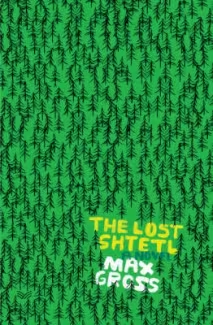
The Lost Shtetl
Synopsis:
The author imagines a tiny Jewish town in modern-day Poland called Kreskol that somehow got cut off from the outside world and survived the Holocaust unscathed, with its customs and traditions intact. When the shtetl sends Yankel, a hapless, functionally illiterate young man, to ask for the government’s help in locating a missing couple, he is soon confined to a mental hospital while the powers-that-be try to determine if he’s a madman.
Revisión
For as long as anyone can remember, a caravan of gypsy traders provides the Jews of Kreskol with their only connection to the outside world. Situated in a remote part of a forest in Poland, the town was inexplicably overlooked by the Nazis, and has retained the traditions of eastern European shtetls or villages from before the Holocaust. Clothes are hand sewn, Yiddish is spoken, the sabbath is observed, the Rabbi is consulted for important life decisions. Think Anatevka of Fiddler on the Roof, without the singing.
This idyllic way of life is upended by the disappearance of a recently divorced young couple whose brief marriage was fractious and violent. Someone has to leave Kreskol to seek the help of Polish authorities. Who better to send than Yankel Lewinkopf?
A 19-year-old baker with a pleasant disposition, he is saddled with an unfortunate yichus (lineage). As the orphaned son of an unmarried prostitute, Yankel is considered to be expendable. Matchmakers will not find him a wife; relatives of his deceased mother do not welcome him in their home.
A trade is negotiated with the gypsies to transport Yankel to the nearest Polish town. As the caravan makes its way onto a paved road and then down a highway, author Max Gross sends the reader on an endearing madcap adventure mingling the past with present-day Poland.
Yankel experiences both wonderment and bafflement each time he comes across a fixture of current-day life. He has no word for phones, post-it notes, Velcro. With no one to ask in Yiddish how they work, he strives in a refreshingly innocent way to make sense of them.
The Polish people he approaches don’t understand his speech, and are hesitant if not hostile when Yankel shows them two pieces of parchment prepared by his Rabbi, asking in Polish and in Yiddish how to contact the police and the Jewish community. Jewish community? What Jewish community?
Unfamiliar with the movement of automobiles, Yankel accidently walks into the path of one. While being treated for his injuries in a hospital, the medical staff becomes concerned by his refusal to eat. He doesn’t partake of the food, of course, because it is not kosher. A Yiddish speaking scholar from a university is brought in to interpret for a psychiatric evaluation. Listening to Yankel’s account of life in Kreskol, the doctors are convinced they are dealing with a madman.
Does Kreskol exist? Not only the psychiatrists but soon the Polish government authorities also want to know – after all, this could be an unexpected source of tax revenue. The journalists, too, see an opportunity here, one that is rife with claims of fake news.
In Jewish folklore there is a mythical town called Chelm whose inhabitants rely on sages who solve problems by cooking up absurd solutions. These tales have provided much needed levity to counterbalance the horrors of decades of pogroms. While Kreskol has some similarities with Chelm, The Lost Shtetl expands the concept exponentially as the ironies of today’s values collide with the naivety inherent in a sheltered existence. The sages of Chelm are cleverly ridiculous. The characters created by Max Gross are more nuanced, flawed, varied, unpredictable and delightful to meet.