Revisión
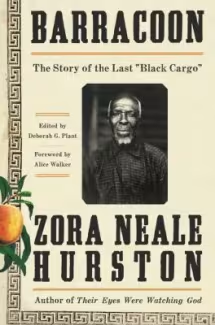
Barracoon: The Story of the Last “Black Cargo”
Synopsis:
This is the full harrowing, first-person narrative of one man's capture, enslavement, life as a slave and his life after emancipation. Zora Neale Hurston transcribed Kossula's remembrances in the original vernacular, as he recounted his experiences as a 19-year-old, in 1860, and how he was captured, tortured, chained, put on a slave ship and taken to a strange place. The date of his capture is important because it is a reminder that even the 1808 Act Prohibiting Importation of Slaves did nothing to stop the insidious practice of importing slaves to the United States.
Revisión
Zora Neale Hurston is well known for her novels, especially for Their eyes were watching God. Her educational background and training were in cultural anthropology, ethnography and folklore. A prolific writer of fiction and non-fiction, this book would not be published in her lifetime because there were quesions about her methodology, and possible plagiarism. In the foreword, Alice Walker points out that black scholars and intellectuals also had issues with the narrative because, "It resolutely records the atrocities African peoples inflicted on each other." It is the full harrowing, first-person narrative of one man's capture, enslavement, life as a slave and his life after emancipation. Hurston transcribed Kossula's remembrances in the original vernacular, as he recounted his experiences as a 19-year-old, in 1860, and how he was captured, tortured, chained, put on a slave ship and taken to a strange place. The date of his capture is important because it is a reminder that even the 1808 Act Prohibiting Importation of Slaves did nothing to stop the insidious practice of importing slaves to the United States.
Hurston scholar Deborah G. Plant researched the original manuscript and has provided background information about Zora Neale Huston's documentation and interviewing methods with Kossola, which provide validation of Hurston's work. There is information about the patronage of Charlotte Osgood Mason, and the shared concerns of both women for Kossola's welfare later in life. There is documentation and appreciation of Hurston's unique interviewing methods that allow the focus to be on Kossula's story, and for Hurston's presence, as the interviewer, to vanish.
The presentation of Kossula's story is very personal, and differs in style and format from the prodigious and valuable fieldwork of The Federal Writers Project (FWP) that was part of the WPA (Works Project Administration). Hurston's work is unique, and so is the work of the FWP and the WPA, which is to be found here at the Library of Congress' Born in Slavery: Slave Narratives from the Federal Writers' Project, 1936 to 1938. The collection of "more than 2,300 first-person accounts of slavery and 500 black-and-white photographs of former slaves," have been digitized, and include an additional 200 photographs. The collection is freely available from our national library, The Library of Congress, where everyone can find rare information about Zora Neale Hurston.