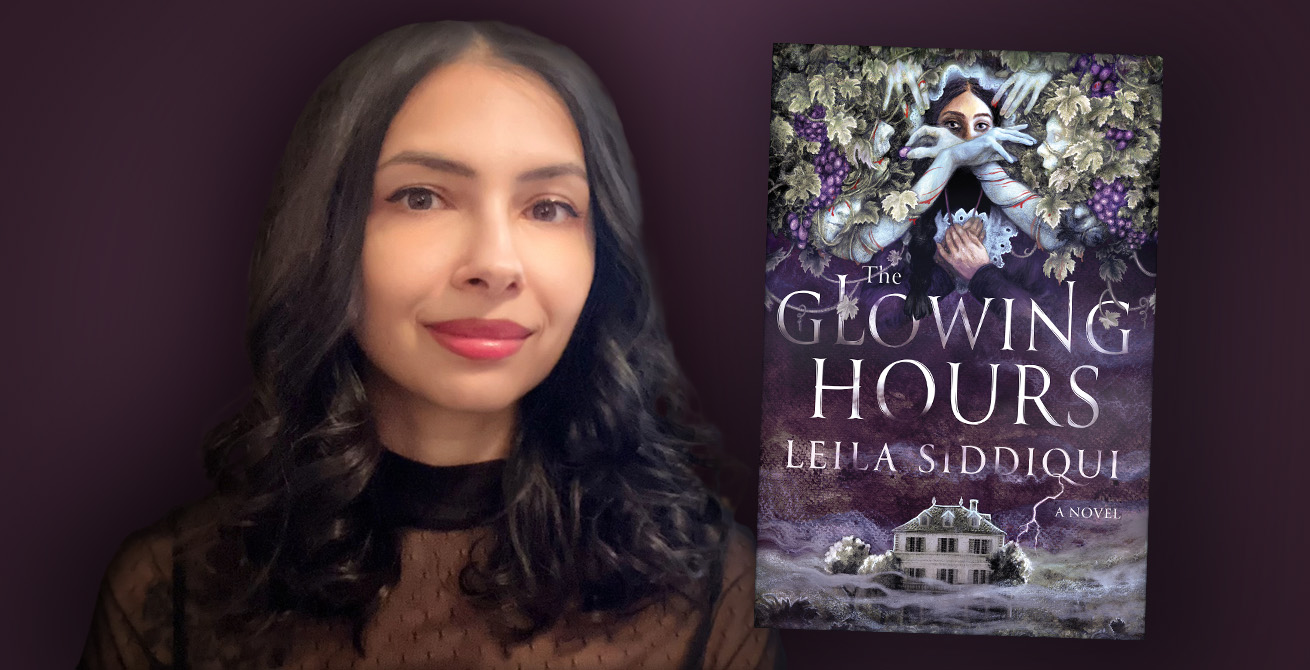
Leila Siddiqui was born in Chicago, raised in Texas, and now lives in New York with her husband. She is also a digital marketing strategist in publishing. When she's not writing, she spends her time worshipping her three very floofy cats, experimenting with vegan recipes from Instagram, and crocheting fun new projects. Her debut YA novel, House of Glass Hearts, was published in 2021. Her latest novel is The Glowing Hours and she recently talked about it with Daryl Maxwell for the LAPL Blog.
What was your inspiration for The Glowing Hours?
I was inspired to write The Glowing Hours because I have always been fascinated with this legendary vacation that these literary geniuses took together. But I have also wondered about what went on during their stay in the Villa Diodati in Geneva. They spent lots of time indoors because it was an unseasonably cold and rainy summer, and would tell ghost stories by the firelight. Lord Byron had challenged everyone to come up with their own ghost story, which resulted in Mary Shelley beginning Frankenstein and John Polidori writing The Vampyre. So I wanted to play with those origin stories, and placing them within the horror genre felt like a great fit.
Are Mehr, Mary, Percy, Polidori, Claire, Lord Byron, Robert, Berger, James, or any of the other characters in the novel, inspired by or based on specific individuals (beyond their historical/literary counterparts)?
I did quite a bit of research on these Romantics and the people in their lives, so I did my best to match them with their histories. I based the characters on themselves, which proved challenging for Mary Shelley. She was very much in love with and influenced by Percy Shelley, which at times frustrated me. But I tried to stay as close to history as possible.
For Mehr and James, I was inspired by what I read in William Dalrymple's White Mughals, which is about a soldier who went to India to find his fortune, married into a noble family, and then deserted his very young wife and took his children with him to England to raise them in society there. It was a tragic story, and there were likely many like Mehr and James who existed.
How did the novel evolve and change as you wrote and revised it? Are there any characters or scenes that were lost in the process that you wish had made it to the published version?
My first draft was very short, only about 40,000 words, and it mostly covered the time Mehr came to London and then began her work with the Shelleys and their travels to Geneva. When I began to revise and expand the word count, I included more research on Mary and Percy Shelley's relationship, and added more of James to the narrative. He did not appear much in the earlier version. I did have a scene between Mehr and her father when they're finally reunited, but it didn't make sense in the final version. There aren't scenes I wish were included. I think the revisions and editing made the novel work as it is.
The setting for most of The Glowing Hours is the summer of 1816, when Mary and Percy Shelley joined John Polidori and Lord Byron in a villa near Geneva. The result of that summer gathering are two of the most famous stories in history: Frankenstein and The Vampyre. How were you feeling when you started writing about such a historically significant literary gathering? Excited? Intimidated? Something else?
I was very excited because I feel like this origin story for Frankenstein and The Vampyre is, at its heart, a Gothic story. These disparate people are holed up in a grand villa, in a foreign locale, where the weather is lashing down around them, this dastardly Lord is controlling them, and they all have secrets of their own. It is the perfect Gothic tale! And how wonderful that, given their circumstances, two iconic horror stories were born during this time. I just had to write it as a horror novel, and I was excited to write it. The story already felt like it was there, it only took a month for me to write the first draft!
How familiar were you with any of these writers and this gathering prior to writing The Glowing Hours? You describe in your Acknowledgments doing some research at the New York Public Library to prepare to write your novel. What was it like to read their personal papers, journals, and published works?
I was familiar with Mary Shelley and Lord Byron and knew quite a bit about their relationship and how they moved in similar circles. I really enjoyed reading their personal papers and journals. It gave me insight into their personalities, but also how they viewed the world around them. Who they liked/disliked. And how they felt about their own lives. I understood that Mary Shelley was deeply in love with Percy Shelley, but also frustrated by his poor financial decisions and inattentiveness. There was drama in their relationship, and I enjoyed teasing that out in the novel.
What was the most interesting or surprising thing that you learned during your research?
What I found most interesting was how little was documented about that summer in the journals and papers. Mary and Percy Shelley kept a shared travel journal, and they mention meeting Lord Byron in Geneva, but then the journal skips to the fall, when they're leaving. They don't write much about what happened in the villa. It's the same with Polidori as well. He speaks at length about the parties he goes to in Geneva, and sketches what his bedroom looks like in the villa, but not much else, and also skips ahead to when they're leaving. Byron wrote a memoir, but after his death, his publisher received it and was so scandalized by what he read, he threw it into the fireplace. So we don't have true firsthand accounts of what really happened, just what Mary writes in the introduction of Frankenstein and some scattered stories here and there. I found that really interesting because people had a habit back then of self-censoring their journals, ripping out pages, or crossing out passages they didn't want people to read in the future. So I think some interesting things happened in that villa, and no one was willing to let it out. I was totally fine with that gap because I was able to write it in whichever way I wanted.
In your Acknowledgments, you also describe researching the history of the British colonization of the Indian sub-continent and how that research was incorporated, along with elements of your own personal history, into Mehr's story. Can you tell us a bit about this and how your story inspired hers?
I mentioned William Dalrymple's White Mughals earlier, and how it inspired the character of Mehr and her brother James. I remember first reading that because I was fascinated by the title. I have done quite a bit of research on the Mughal Empire itself, so the title caught me off-guard. But it really gave me insight into my own ancestral history, and how British colonialism really impacted India at the time, how so much culture was changed because of British influence. So much of my existence is because of colonialism. Growing up, there were certain things instilled in us, like particular manners, how we ate, how we dressed, our complexions, that it is clear we're still impacted by it today.
Many years ago, my family did a DNA test through the Human Genome Project out of sheer curiosity. My mother had mentioned her grandmother was a very pale woman, and I was always fascinated by our genetic history. It turned out about half our genes were actually from South Asia. The rest was scattered around the Asian continent. We had a significant amount of Mediterranean and Northern European, about a quarter of our genetics. And so, I know that so much of that has to do with conquests and colonialism, and maybe there was a Mehr in my family somewhere.
There is also a story in my family that on my mother's side, my ancestors were the caretakers of the shrine of Sheikh Moinuddin Chisthi and that the first son in each family was to take up the mantle and devote their lives to it. However, one son decided he wanted to live a more worldly life and so it was passed to his cousin and moved away from my mother's side of the family. I put this little tidbit in the novel where Mehr often uses her family relation to Chisthi in an arrogant way to say she is above all of the menial housework she has to do!
Do you have a favorite Frankenstein adaptation or pastiche (novels, films, and/or series)? Do you have a least favorite? (I realize that you may not want to address this one, and if that is the case, please don't. But I also realize it might be so bad that it could be fun to answer.
I'm super loyal to the novel so I actually have a hard time watching other adaptations of it. I would be too distracted pointing out similarities and differences.
Same question for vampires: a favorite novel, film, or series? A least favorite?
Recently, I really loved what the film Sinners and the book The Buffalo Hunter Hunter did with the genre. Both were so inventive and original that it inspired me to perhaps try and write my own vampire novel!
If/when The Glowing Hours is adapted, who would your dream cast be?
I'm not entirely sure! They would all have to be quite young and in their early twenties and not I'm not clued in on young Hollywood as well! I would love for The Glowing Hours to be adapted and would welcome any casting to it.
If you could ask a question of the Shelleys, Polidori, or Lord Byron, what would it be?
If I could speak to them, I would want to tell them about their legacy. I think they would find it fascinating that the impact their work has had on the world. Especially Mary, since she was so focused on Percy's legacy during her lifetime. I'd love for her to see how influential Frankenstein became on the world.
Is there something you wish you could tell any of them?
I would definitely give Percy a piece of my mind on how he's been treating my girl Mary!
What’s currently on your nightstand?
I have a stack of books, and in no particular order, they are Stephen King's It, which I haven't finished but am about 75% of the way through. A crossword book. A Murdle book. And two galleys I got from ALA last year: Blood Slaves by Markus Redmond and How to Survive a Horror Story by Mallory Arnold.
Can you name your top five favorite or most influential authors?
In no particular order: Stephen King, Silvia Moreno Garcia, Stephen Graham Jones, Toni Morrison, and Ray Bradbury.
What was your favorite book when you were a child?
I really loved The Nine Lives of Opalina about a ghost cat going through all of her lives over history. It was the first book I read over and over again. I believe it's now out of print!
Was there a book you felt you needed to hide from your parents?
I had to hide a lot of books from my parents. Being a child of immigrants who put a lot of emphasis on schoolwork and how getting good grades was the gateway to the American Dream, they thought we kids read too many novels and were being distracted from our homework. So for a while, we had to hide what we were reading, and it made it even more illicit and fun. I still really cherish the times now as an adult when I can turn off the rest of the world and focus on my reading.
Is there a book you’ve faked reading?
In high school I barely read A Tale of Two Cities. I don't know why I didn't use any of the summer to read it, and we had to do a report on it as soon as the school year started. So I did my best with Spark Notes, which I also barely read. I have no idea what I put in that report, but I also definitely failed it. That book is such a trigger for me! All I know is that the two cities are London and Paris, and maybe there's a war? I still feel itchy thinking about that book.
Can you name a book you've bought for the cover?
Definitely The Moonstone by Wilkie Collins. I remember the cover had this sepia tone on it and Indian men staring out. I had no idea what this was, but I had to have it. It would be another decade or so before I'd read it, and well, let's just say it definitely contributed to my research and fascination with colonialism.
Is there a book that changed your life?
There's no one particular book, I feel like all books have had an impact on me in how I write or what I'm inspired to write. Lately, I've been really inspired by the work of Stephen Graham Jones and what he's done for the horror genre. I strive to push myself and create with both horror and heart the way he does.
Can you name a book for which you are an evangelist (and you think everyone should read)?
I always find myself recommending Tananarive Due’s The Reformatory. I feel like it is one of the most perfect modern Gothic horror novels I've read. It's one of those books where you just know you're in the hands of a master storyteller, and you're in such incredibly capable hands that you want them to take you with them on this journey. I was hooked from the first page, and the storytelling is just so exquisite that I found myself completely lost in the pages.
Is there a book you would most want to read again for the first time?
I am actually reading Jonathan Strange & Mr. Norrell again for the second time. I am picking up on so many fun little details I missed on the first read. It's very immersive, and I'm happy to return to that magical little world.
What is the last piece of art (music, movies, TV, more traditional artforms) that you've experienced or that has impacted you?
Definitely the film Sinners. It made me want to be a better storyteller and really push myself to the limits of imagination and creativity.
What is your idea of THE perfect day (where you could go anywhere/meet with anyone)?
Going to the library! Having a full, uninterrupted day where I can hide from society, and move around the shelves, pluck some interesting books, make a long, lovely stack, and then find a comfy table and chair to just read read read.
What is the question that you're always hoping you'll be asked, but never have been?
Haven't thought of one yet! But these questions have all been interesting.
What are you working on now?
I'm working on a few historical novels that play with different horror elements. A historical slasher, a novel with dual timelines (1600s India and 1920s New York) and a centuries-old conspiracy that comes to light between them, and a colonial era retelling of a popular piece of media. Forgive me for being vague, but I can say they're all in the horror genre and all have some strains or are touched by my family history and ancestry.