Review
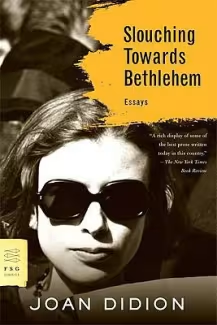
Slouching Towards Bethlehem: Essays
Synopsis:
The Scheherazade of the essay, as she lures you in with that first sentence, and then takes you places never imagined. She melds analysis and emotional reactions, which takes time and talent to do well.
Review
During this century, Joan Didion has become somewhat better known for personal tragedies, which she wrote about in The Year of Magical Thinking. When it was published, I could not finish reading it, and still have not. Long ago, in the last century, the first book of hers that I read was Slouching Towards Bethlehem, a collection of essays. It may have been assigned in a high school English class, or I found it in a small local bookstore. The subject matter was timely and the writing style was clear with underlying layers of complexity, and like nothing else I had read. A new book, Slouching Towards Los Angeles: Living and Writing by Joan Didion’s Light, has brought me back to her work. The collection of criticism is not being reviewed. If you have not read any of Didion’s books, then do yourself a favor and put off reading this new book, which is a collection of critical and personal essays about many of her books. I am all in favor of reading the original works first, form your own opinion, and then see what someone else has to say.
I have been rereading four of Didion’s books: Slouching Towards Bethlehem; The White Album; Political Fictions; South and West. All of them are in e-media. You cannot be a casual reader, and you cannot skim over her essays. You will be driven to a dictionary and/or an encyclopedia. I still am, and in rereading one of her essays, came upon Couéism, and wondered what the devil she was referencing, and why in that particular essay. In The White Album, there is an essay, “The Getty,” which was about the Getty Villa, on Pacific Coast Highway, when it opened in 1974. Rereading it takes my breath away, in part because of my own assumptions: Didion is going to critique the villa and its collection of art, and the man, J. Paul Getty, the mega petro-industrialist, whose earnings fed the needs of the collector. She kind of starts there, but finishes with a coup de grâce aimed at unexpected targets.
She has a cool, almost clinical writing style that serves her very well in skinning back what is of interest. Like a master duelist, calm and deceptive in appearance, but having focus and clarity, she always strikes the mark. She makes you think about what she is writing; she makes you think about other events and ideas; she slowly stirs it up, and you are definitely shakened and awakened to thoughts you never had. Joan Didion is a wise exemplar, a master of critical thinking and how to write well to express thoughts and ideas.
No one writes like her, because no one thinks like her. This was never put more concisely than by Nathaniel Rich in the foreward to South and West. He said that her stated goal was counterintuitive. Didion wrote, “I had a theory that if I could understand the South, I would understand something about California, because a lot of the California settlers came from the Border South.” After reading the essays and notes in the book, his mind was changed, “Didion saw her era more clearly than anyone else, which is another way of saying that she was able to see the future ... Joan Didion went to the South to understand something about California, and she ended up understanding something about America.”
Reading the new collection of critical essays has given me pause to rethink some of my opinions about her other books--the novels, which I was not so fond of, so long ago, and plan to reread.