Review
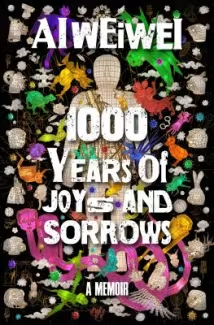
1000 Years of Joys and Sorrows: A Memoir
Synopsis:
Ai Weiwei is one of China’s most famous and infamous internationally known artists. On April 3, 2011, as he was about to fly out of Beijing's Capital Airport, he states, " ...a swarm of plainclothes police descended on me, and for the next eighty-one days I disappeared into a black hole." The title of the book is part of a poem written by his father, Ai Qing, who was imprisoned during the Cultural Revolution in China. This book is a memoir about his father, himself, his country, and the necessity for freedom of expression everywhere in the world.
Review
Ai Weiwei is one of China’s most famous and infamous internationally known artists. His artistic style ranges from representational to pushing boundaries all over the place. Not only in his visual work has he stretched and pushed, but in his thoughts, ideas, and comments about his native country and its lack of expressive freedom; its authoritarian disregard for humanity and oppression of different types of people within its own borders, as well as supporting various types of repression throughout the world. This drive to express, and lack of concern for his own safety, landed Ai Weiwei in prison and under torture. It might be part of his family’s tradition, in that his father Ai Qing, once a celebrated poet and friend to Mao, was sent to a horrific labor camp, where Ai Weiwei grew up—in exile in his own country. Born in 1957, it was a time according to Ai Weiwei of the "New China, and, "In satisfying the demands of the new order, the Chinese people suffered a withering of spiritual life and lost the ability to tell things as they had truly occurred." His father was among those who dared not speak about what had taken place, for fear of further punishment and mistreatment.
On April 3, 2011, as Ai Weiwei was about to fly out of Beijing's Capital Airport, " ...a swarm of plainclothes police descended on me, and for the next eighty-one days I disappeared into a black hole." It gave him time to reflect on his father, and part of his country's history that was blocked out of existence, and fear silenced many of its citizens, who were unable to talk about what had taken place and how they had been treated. Looking back at his own history, it is multifaceted. After Mao’s death and the end of the Cultural Revolution, the family returned to Beijing, where Ai Weiwei studied art and animation. From 1980 to 1983, he was allowed to leave China and study in the United States, which was a great awakening for him, being able to learn about all types of artists, art forms, and freedom of expression. In 1993, he returned to China because his father was ill, but the artist continued expanding his artistic forms of expression, until it was more than the Chinese government could bear, and he was arrested and his passport was confiscated. In 2015, his passport was returned to him, and he moved to Berlin; later to England, and now lives in Portugal.