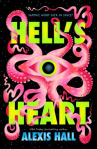
Some years ago—never mind how long precisely—having little or no money in their purse, and nothing particular to interest them on shore, Alexis Hall thought they would sail about a little and see the watery part of the world. Unfortunately, the boat they were in sank with all hands, and they were rescued only by a passing whaler. They have since become a novelist. Their latest novel is Hell's Heart and they recently talked about it with Daryl Maxwell for the LAPL Blog.
What inspired you to reimagine Herman Melville's Moby Dick as a "space opera"?
So, usually I don't have a cool "where did you get the idea for this book" story, but Hell's Heart is the one exception to that. You might remember that back in 2020, there was this whole thing called "lockdown", and we were all stuck in our houses and desperate for ways to distract ourselves.
"I know," I said. "I'll read a famously long book at one chapter a day and then, when lockdown ends, and I haven't finished, because obviously we won't be stuck in our houses for more than 135 days, it'll seem like it went really quickly." That plan…did not work. But I did read Moby Dick, and every day I posted on The Website Formerly Known As Twitter about the chapter, with an emphasis on the bits that were silly, suggestive, or weirdly obsessed with flukes. And it actually did make the first 135 days (136 technically since there's also the epilogue) much more bearable.
And because I'm a professional novelist, I naturally got to thinking "how would I do a take on this," and while I briefly flirted with "it's fantasy, and instead of whales it's dragons," I settled on "it's on Jupiter, and the whales are psychic space monsters." I think one of the reasons I went with the SF direction rather than the fantasy direction was that something that's really clear in the text of Moby Dick is that the whale, on some level, represents the unknowable. There were no cameras in 1851, so the only way to see one was to go to sea in a wooden ship with sails, and it's really hard for us, in the present day, to imagine how big a deal that would have been. I think space is a much clearer way to explore that because I think we do still have an intuitive sense that space exploration is dangerous and that space is unknowable and vast beyond our comprehension.
Anyway, I stuck that idea in a metaphorical drawer for over a year. But in…2022, I think, my agent was talking to somebody from Tor, and she asked them the classic "what's your dream pitch" question, and they came back with "Moby Dick as a romance." To which my agent very roughly replied: "Hold my client's beer."
Are the Narrator, Q, A, or any of the other characters in the novel, inspired by or based on specific individuals (beyond their literary counterparts)?
Basically, no. The whole Starry Wisdom thing is inspired by Lovecraft, but it's not literally based on the man directly. And obviously part of the point of the book is for it to be About AmericaTM in a way that's reflective of the original book, so you could probably read RL analogues into, for example, the whole part with the power struggle between true believers and obvious grifters for control of a right-wing personality cult but nobody is, like, directly based on a single specific real human being.
How did the novel evolve and change as you wrote and revised it? Are there any characters or scenes that were lost in the process that you wish had made it to the published version?
The book actually got longer in revision rather than shorter (joy of working in a genre where doorstoppers are still something of the norm, if less so than they were 20 years ago). I did tighten up the intro, so there were originally two scenes with the recruiters, for example. And I briefly toyed with an analogue for the character of Elijah in the original book (the guy who shows up at the very start to be all "don't get on that boat, you'll all die" to set up the book's themes of prophecy and predestination). But that's not something I wish had been in the final version. I very much trust my editors, and it's very rare that I'll cut something and not agree that cutting it made the text better overall.
There's actually a little bit more to say about the editing process here than there usually is because one of the bits of Melville scholarship I discovered while writing is that there's a general consensus that he did very heavy rewrites, and there's a certain branch of the literature that's all about trying to work out which elements of the text came from which versions. Like there's at least one paper which suggests that probably in one version of the text Bulkington took on more of the role that Queequeg takes in the final book, and that Peleg and Bildad would have actually been running the ship instead of Ahab.
And as a kind of tribute to this, there's a lot of places where, when I made a change in editing, I openly says that she's made a change in editing. There are a lot of places where I directly talks about the process of writing, and that's often at least influenced by the stage of the writing process I was really in at the time.
Most of your previously published works are romance (sometimes infused with influences of other genres). Are you a fan/reader of science fiction? Can you tell us about some of your favorite writers or filmmakers? Favorite novels, short stories, or films?
I have very eclectic tastes, but I very much grew up on SFF. Red Dwarf and Babylon 5 were two of my favourite TV shows in the 1990s and the Hitchiker’s Guide series were some of my favourite books. I'm also very much a subscriber to what you might call the "weird fiction" model of SFF, in that I don't necessarily think that drawing a hard line between science fiction and fantasy is always sensible.
Case in point, one of the biggest non-Melville influences on Hell's Heart was the Locked Tomb series by Tamsyn Muir—and those are definitely science fiction but, like, they also have wizards in them.
Hell’s Heart would make an amazing film or series! If/when it is adapted, who would your dream cast be?
For what it's worth, with adaptations it's always an "if" not a "when" (RIP Buffy reboot) especially when you're dealing with something that needs, y'know, space battles. And I don't normally dreamcast my own books because I like readers to be able to imagine the characters how they want. It gets particularly tricky when you're dreamcasting a book that's canonically set in a society that, aside from one weird apocalypse cult, is explicitly post-racial. There's absolutely no reason that any character in the book couldn't be played by an actor of any ethnicity (with the slight caveat that we know I's skin is darker than Marsh's because they have a conversation about it, and Marsh cares about that kind of thing because he's in the aforesaid weird apocalypse cult). I always worry that there's a chance that if I say, "I imagine character X played by actor Y," then it'll become people's headcanon that character X has to look exactly like actor Y in any adaptation. About the only exception here being that I is canonically trans, so would need to be played by a transfem actress.
Having done that rather long preamble, as it happens, I was asked for some visual references for the characters for art on the cover of a subscription box edition, so I did actually have an answer to this, but it really is just one potential answer. Very briefly, I imagine A as having a bit of a Michelle Yeoh vibe partially just because I'll take an excuse to cast Michelle Yeoh in anything. Based largely on her turn in The Expanse I think Frankie Adams would be a good shout for Q. I think Yasmin Finney could be good for I. But again, this is very "gun to my head, have to pick somebody," not "final word of god."
Is Moby Dick your favorite of Herman Melville's? If not, what is?
I'll be honest, I'm not that broadly familiar with Melville's other work, although to be fair, I think very few people are, and there's an interesting quirk of history where the way his work is received today is pretty much the opposite of how it was received way back when. His first two books were quite straightforward adventure stories, which he claimed were autobiographical and which modern scholars think were at least mostly based on his real experiences. People at the time absolutely loved them, whereas today they're not really what he's best known for. Then (and I'm skipping over some stuff here) Moby Dick came along and it absolutely bombed because people wanted more like his first books, and instead it was this dense, metaphysical book about themes, and his career never really recovered.
Do you remember when you were first exposed to Moby Dick? Was it the novel or one of the films? If it was one of the films, which one?
So I didn't actually read the full book or watch any adaptations until 2020 (see above)—I get the impression a lot of Americans study it in high school, but we don't over here. So, prior to that, my exposure to the book was through reputation and the broad cultural repetition that, today, we'd just call "memes." Honestly, there's a good chance that my first exposure was a parody in a cartoon. The recent reference that most stands out to me—so much so that I directly quoted it in the Extracts section—is the "Moby Dick the Musical" flashback sequence in Crazy Ex-Girlfriend. The only bit of the score you see is "Ahab can't you see, the whale is a metaphor," and that got so stuck in my head that it's become my default way of saying that any element of any text is meant to be read as allegorical.
Although now that I'm much more familiar with Moby-Dick, I will say that if there's anybody on the Pequod who doesn't need to be told that the whale is a metaphor, it's Ahab. Like that's the entire difference between him and Starbuck.
Do you have a favorite of the film adaptations?
So I've not actually watched any of them. I did watch In the Heart of the Sea which is about the wreck of the Essex, one of the RL events that's said to have inspired the book (and by "said to have inspired" I mean "is directly and explicitly referenced in").
Were you intimidated at the idea of reimagining such a well known novel and its characters?
I'm not sure I'd say "intimidated" but I did try to approach it with respect, especially because—as I said above—a big part of what I wanted to capture was the "this is really about America" vibe of the book and as you might be able to tell from my spelling, I'm not an American. Plus, obviously, the original touches on a whole range of topics that are as pertinent today as they were 175 years ago, some of which also make sense in a deep-future post-Earth society and some of which didn't, and so there was a lot to be careful with around that too. I will say that the specific "literary classic" of it all didn't hugely bother me. I tend to think that the classics are big enough to take care of themselves, and we can be too reverential of this kind of thing. Like I'd have zero qualms (and have had zero qualms) about riffing on Shakespeare.
We lost Herman Melville in 1891. If you could ask him something, what would it be?
I'm a massive nerd about these kinds of things, so if I could speak to anybody who actually lived in the 19th century, I'd want to grill them about the kinds of trivial details of day-to-day life that tend not to make it into the historical record. The other thing here is that Melville died in 1891, but he was born in 1819, so he got to see a good chunk of that century, and I think it'd be really interesting to ask him what sorts of changes he'd seen over his lifetime. I think it's very tempting to look back from the 21st century and see the whole of the 1800s as nonspecifically "Victorian times," but I suspect that to the people who actually lived it, 1891 was as different from 1851 as the 1990s were from the 1950s.
Is there something you wish you could tell him?
Looping back to the whole thing about his later work not being appreciated in his lifetime, I think "you will eventually be remembered as one of the greatest writers in American history" would probably be really comforting to him.
Do you have a theory regarding why the works of Herman Melville, in general, and Moby Dick specifically, continue to be popular with readers, writers, and filmmakers?
I'm always a bit careful about this kind of thing because I simultaneously want to be respectful of the classics while also being a bit uncomfortable with how much effort we, as a society, put into celebrating the genius of specific dead white men.
To go off on a complete tangent that I promise will become relevant to the question, there's a film called Yesterday about a struggling songwriter who wakes up one day to discover that the music of the Beatles has been completely erased from history. The version of the film that exists is a feel-good movie about how he becomes a mega-success by recreating the Beatles' music, but then ultimately comes clean, and the whole thing is a celebration of how gosh-darned brilliant and universal the Beatles are. The version of the film that the writer originally wrote, and which, as I understand it, he's rather bitter at the changes to, is a much bleaker and (to my mind) more interesting story. In the original version, the struggling songwriter wakes up, discovers that everybody's forgotten the Beatles, tries to find success with that music, and still fails. It's about how success is arbitrary, about how hard work and talent aren't always enough, and how even works we today consider iconic would vanish without a trace if they didn't get the specific concatenation of circumstances that came together to make them icons.
Ultimately, Melville is iconic today because he existed in a time and place that meant his work could become (eventually, many years after his death) synonymous with the idea of the "great American novel". I'm not saying that the creative choices he made weren't part of that; certainly, his decision to try to write a book that speaks to universalist ideas and uses powerful, striking images which people can project their own interpretations onto endlessly, in multiple iterations across decades and indeed centuries (well, 1.75 centuries) is part of that. But the book sank without a trace at the time, and if it hadn't happened to be rediscovered by some very influential people in the 1920s, it may have remained forgotten forever. And, in that alternative reality, if somebody pulled a copy of Moby Dick off the shelf in 2026, they wouldn't necessarily see anything special in it. To be clear, this isn't me throwing shade on Melville, but part of what makes a classic a classic is, circularly, the context of its being a classic. Moby Dick is a great book, but part of what makes it the cultural juggernaut it is today is the fact that we've all spent our whole lives with "the white whale" as a cultural constant. Knowing that the book has meaning to so many other people is part of what gives it meaning. The same is true of Shakespeare. It's not that his plays are transcendentally better than anything else that any human being has written in English; it's just that being Shakespeare is an inseparable part of their impact.
What's currently on your nightstand?
An e-reader, a sleep mask, and a scented pillow spray.
What is the last piece of art (music, movies, TV, more traditional art forms) that you've experienced or that has impacted you?
Going back to the Shakespeare thing, it's actually a production of A Midsummer Night's Dream I saw a couple of weeks ago (at time of writing). Normally, when people do modern takes on AMND they kind of gloss over things like "Theseus is forcing Hippolyta to marry him when she's basically a prisoner of war" and "love potions raise some really serious consent issues" and "the major comic beat is about a man sexually humiliating a woman for defying him" and "we're repeatedly invited to mock working-class people for being working-class".
The version I saw more recently approaches those topics with a lot more intentionality. It frames Theseus as a tyrant who is forcing one woman into marriage and trying to force the same on Hermia; it gives the rude mechanicals genuine dignity as working people forced to dance for the entertainment of rulers who have nothing but contempt for them. It's a really nuanced and at times genuinely shocking take on the play (Theseus straight up murders Bottom at the end) but, looping back to my earlier comment about classics being classics because of their context, not their individual merits, as a piece of theater it makes no sense outside the context of Midsummer Night's Dream being an existing play with centuries of performances already behind it. It's impactful because the audience already knows the original and its context. It hits as hard as it does because you're not just reacting to the play, you're reacting to all the other times you've seen the play and taken it at face value.
What are you working on now?
A light-hearted romcom-adjacent romantasy novel about two princes in an arranged marriage, one of whom is Lawful Good, and the other of whom is Chaotic Evil.