In late November 1970, Abigail Lois Cleaves, a Los Angeles resident of more than fifty years, passed away. Gail (as she was more commonly known) had been a Civil Engineer with the Los Angeles County Highway Department until her retirement in 1960. Her final years were spent in an assisted living facility in Newhall, where she was forced to relocate after the 210 Freeway took out her San Fernando home. Eminent domain, however, wasn't the only indignity Los Angeles would heap on this woman. Only a few years prior, Los Angeles had deprived Gail Cleaves of the one achievement she assumed would live in perpetuity, a contribution made to the City of Los Angeles during one of its darkest hours. For nearly three decades, Cleaves' magnum opus was a sentinel of sorts for Central Library greeting any and all seeking knowledge, escape, and enlightenment. Gail's gift not only acknowledged a promise to Angelenos that the City of Los Angeles would forge a library system that would make Los Angeles a better place, but it also codified it. Then one holiday season, Cleaves' composition disappeared, never to be seen again. This is the story of that lost achievement.
Gail Cleaves was born in Aurora, Illinois, in 1894 and was the youngest of six children born to Alfred and Mary Cleaves. Sometime around the turn of the century, the family relocated to Pleasant Plains, Staten Island, where "Abbie" graduated from Curtis High School. After graduation, Abbie would stay in New York to study both commercial art and engineering. As an artist, Cleaves was gaining momentum with exhibitions at the New York Civics Club and Aeolian Hall. She was commissioned by Aeolian Hall to draw portraits of musicians, including Josef Hofman, and helped design at least one stage production. This experience led to a job in Minneapolis, but she didn't stay there long. She arrived in Los Angeles in 1920 and began pursuing a career as a commercial artist, before joining L.A. County's Highway Department.The limited biographical information available on Cleaves indicated that was particularly adept at conceptual sketches and her work was largely connected to building bridges. She appears to have pursued art commissions on the side though it is difficult to identify anything significant she may have created after 1935.
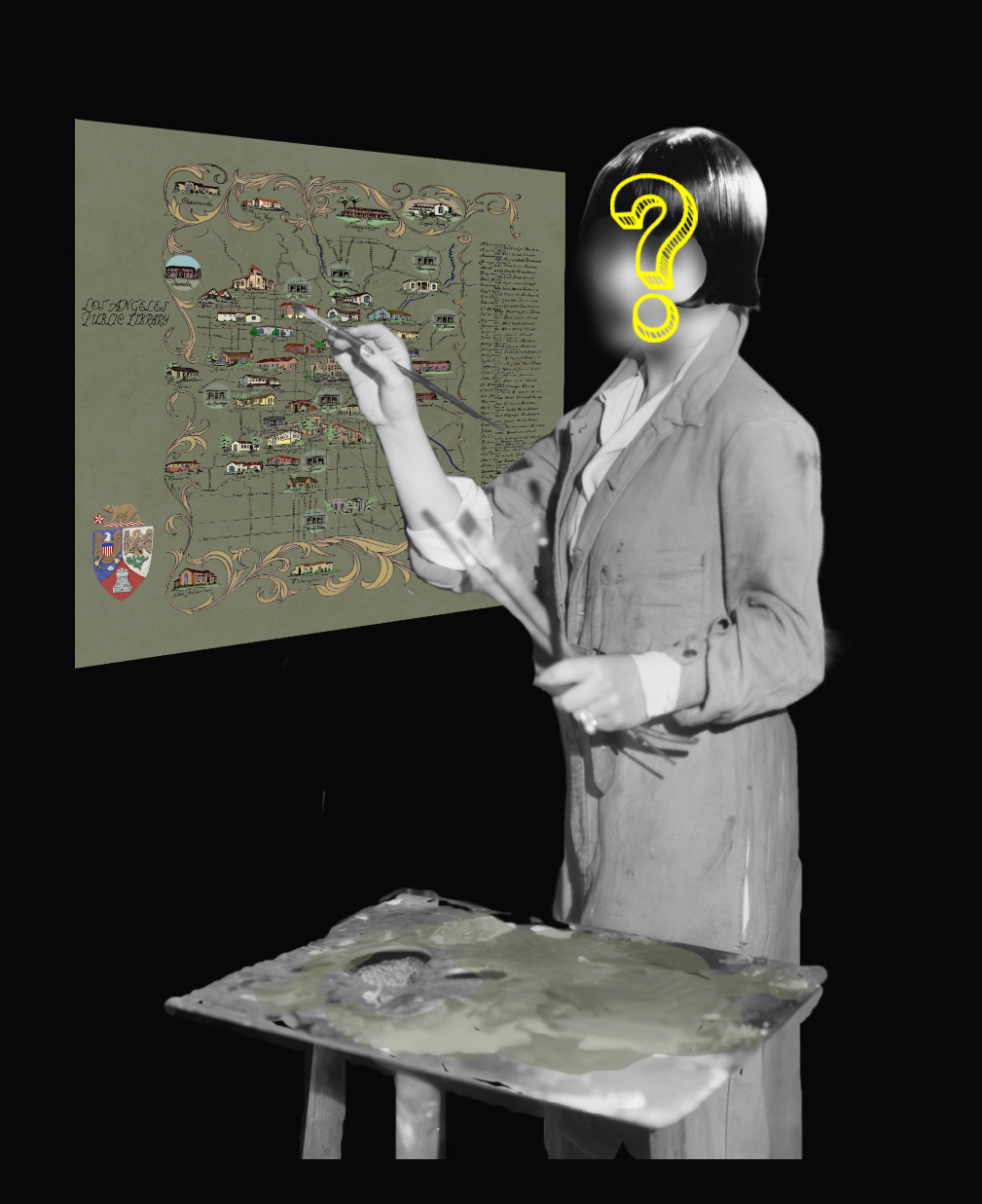
There isn't much in the way of personal information on Gail Cleaves (this includes finding a photograph to pair with this essay), and with closer inspection, it's easy to understand why she may have been guarded. Edan Milton Hughes' Artists of California describes Cleaves as a "spinster," and, indeed, she was never legally married, though she had the same "roommate" for more than forty years, a woman named Bessie Esterly. Esterly (nee Cox) was a two-time divorcee who ran a beauty shop near Lafayette Park, which made the papers one morning in 1939 when a driver lost control and plowed through the shop window. This accident appears to have been the lone intrusion into the otherwise quiet lives of Cleaves and Esterly. The pair moved around Los Angeles over the years before retiring into a mobile home park in Sylmar in the 1960s, where Bessie would pass away in 1964. The extension of the 210 Freeway in the late 1960s would displace Gail, sending her to the aforementioned assisted living facility in Newhall, where she died in 1970.
So what is this mysterious "gift" I alluded to in the first paragraph? Well, let me set up the context in which Cleaves' gift arrived at Central Library. Central Library opened in 1926. Three years later, the Stock Market crashed, and the Great Depression followed, with the bleakest year generally considered to be 1933. In the wake of that darkness, the Federal Government set up a program, the Public Works of Art Project (PWAP), to commission professional, accredited artists to create works of art for public spaces. The program operated under the auspices of the Treasury Department and was chaired by a man named Edward Bruce. The country would be divided into sixteen regions, with the Southern California region (essentially everything from Paso Robles to San Diego) designated as Region 14. Merle Armitage, a renowned set designer, founder of the Los Angeles Grand Opera Association, and a manager at the Philharmonic Auditorium on 5th and Olive Streets, served as "Regional Director for Southern California."
In an article written for California Arts & Architecture magazine, Armitage revealed that he relied on a committee of individuals throughout Southern California to "insure a fair and impartial judgement as to the artists to be employed, a committee of broad sympathies, sound judgment and catholic tastes... " Some of the more familiar local names included Samuel T. Clover (editor of Los Angeles Saturday Night magazine), Cecil B. DeMille, Millard Sheets, and Arthur Millier (Art critic of the Los Angeles Times). Near the end of the PWAP program, Bruce sent a letter to Armitage commending both Armitage and Region 14 for its outstanding participation in the project: "Your committee has secured more cooperation from the public and the artist and a larger contribution of money than any other regional committee in the United States." The "contribution of money" phrase is a little misleading, as there was no financial exchange between the artists and the institutions that housed their work, as the funding came from the federal government. The phrase likely refers to the fact that institutions often paid for materials to realize the proposed artwork. PWAP was short-lived, operating from December 1933 to May 1934. The program reportedly resulted in more than 15,000 works of art, including more than 7,000 paintings. Central Library was the beneficiary of two PWAP-backed artworks: a fresco by Charles Kassler depicting a bison hunt and a painting by Miss Gail Cleaves.
In January 1934, the Los Angeles Art Survey Committee of the Los Angeles Art Association (an organization that was founded in 1925 and remains in operation today) began surveying locales for the public exhibition of art in Los Angeles. The survey committee consisted of five prominent Angelenos, including philanthropist Queen Walker Boardman, socialite Edna Porter Philips, Allan Bennett, John H. Whitely, and Philip Ilsley, Chairman of the Paddock Engineering Company (and a man called the father of the modern swimming pool). The committee was organized to help work with PWAP, and they were largely responsible for finding and securing locales for public art throughout Los Angeles, including Central Library. For final approval, however, the request had to be funneled through the Los Angeles City Municipal Art Commission. The Municipal Art Commission was organized by private citizens in 1903, but became a civic entity as part of the Los Angeles Charter of 1911. The Commission's role was to approve the purchase or acceptance of any work of art by the City, as well as to determine the placement of the art. It's reasonable to assume there might have been some skirmishes between the Municipal Art Commission and the Art Association, but they didn't seem to make it into the Library Commission minutes.
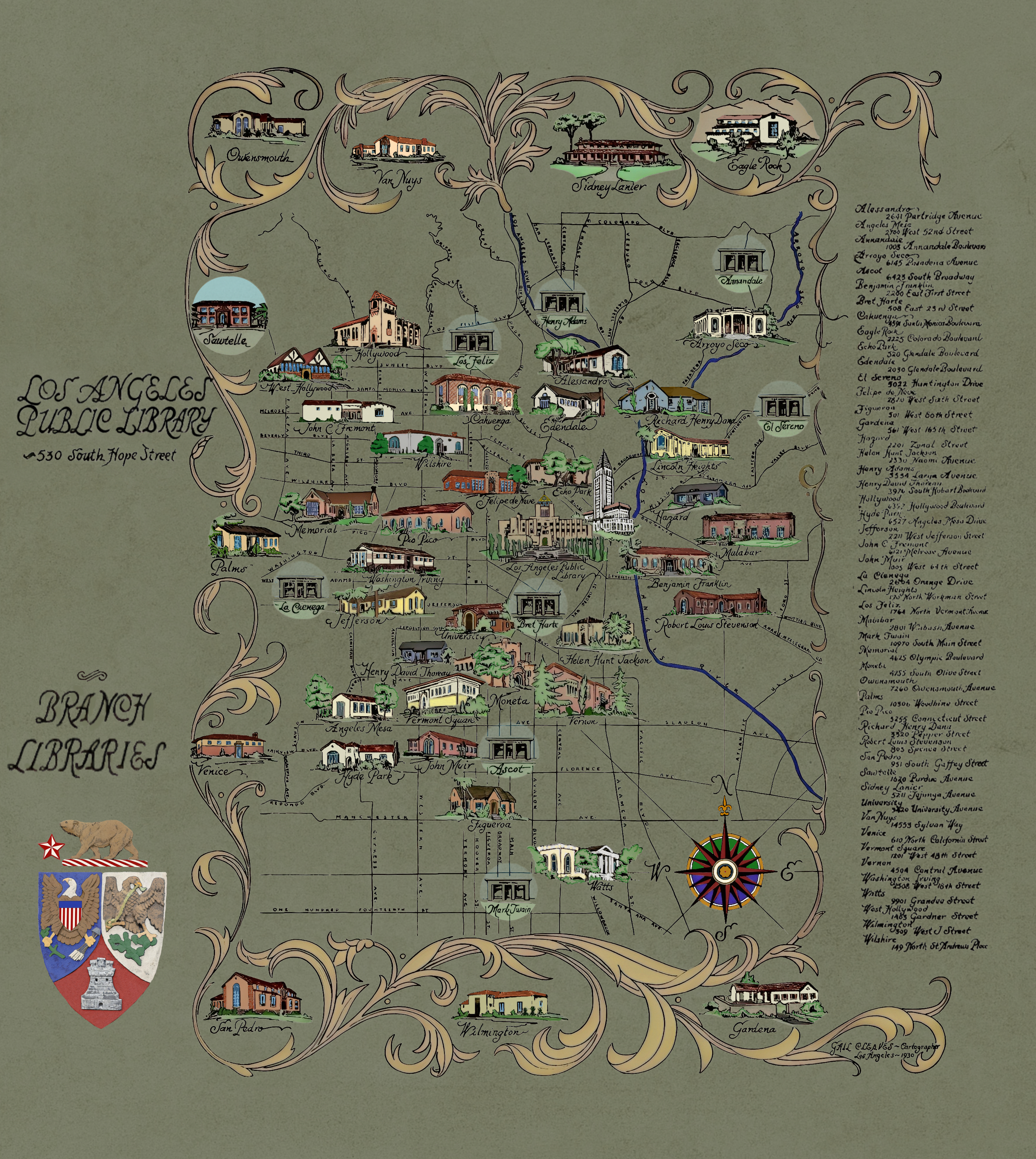
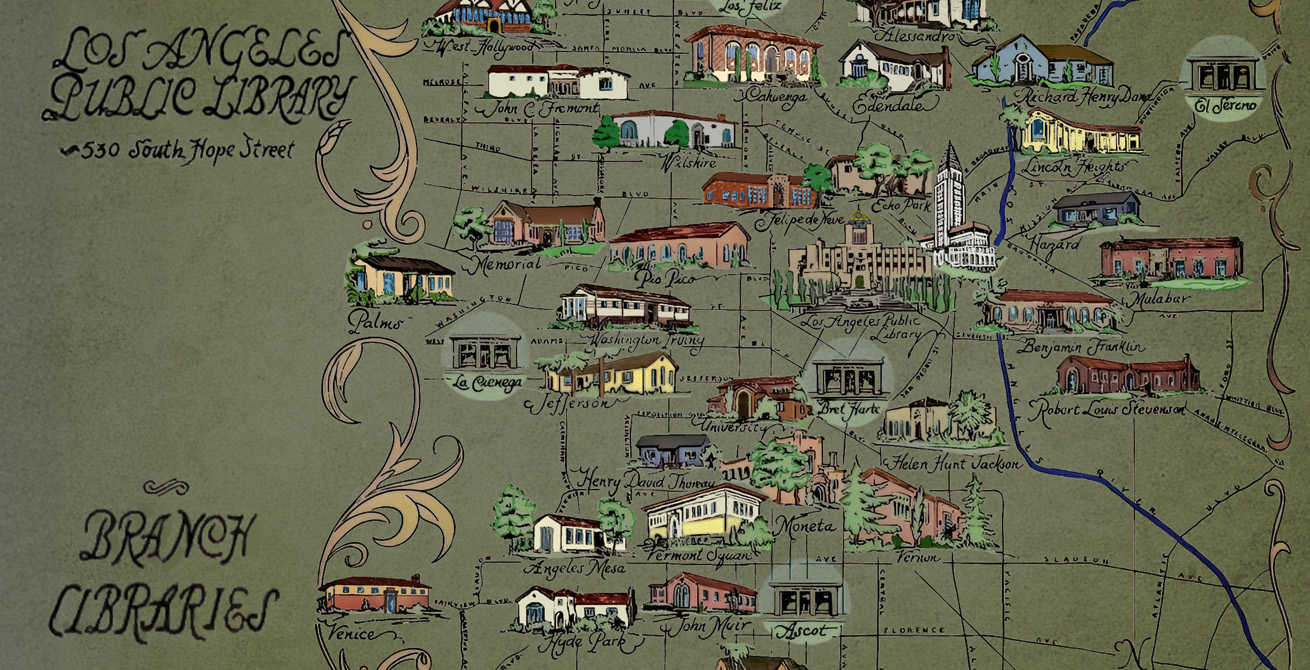
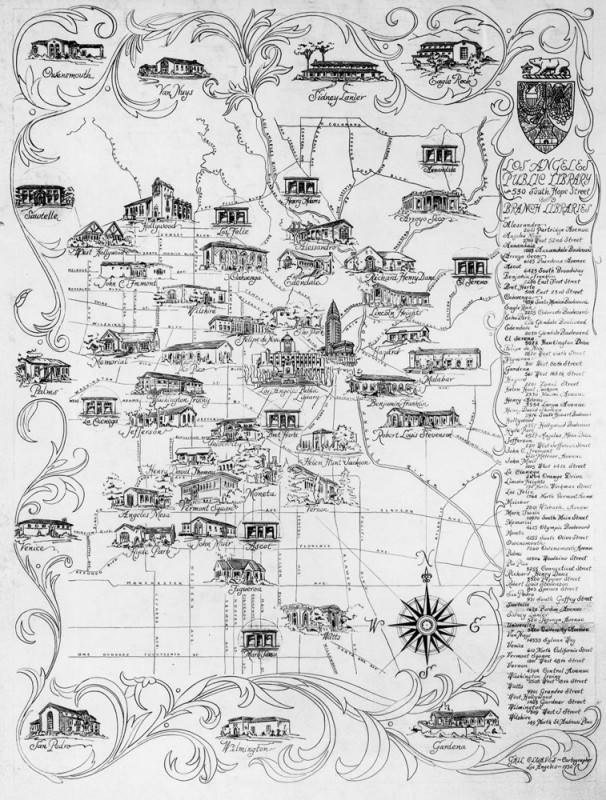
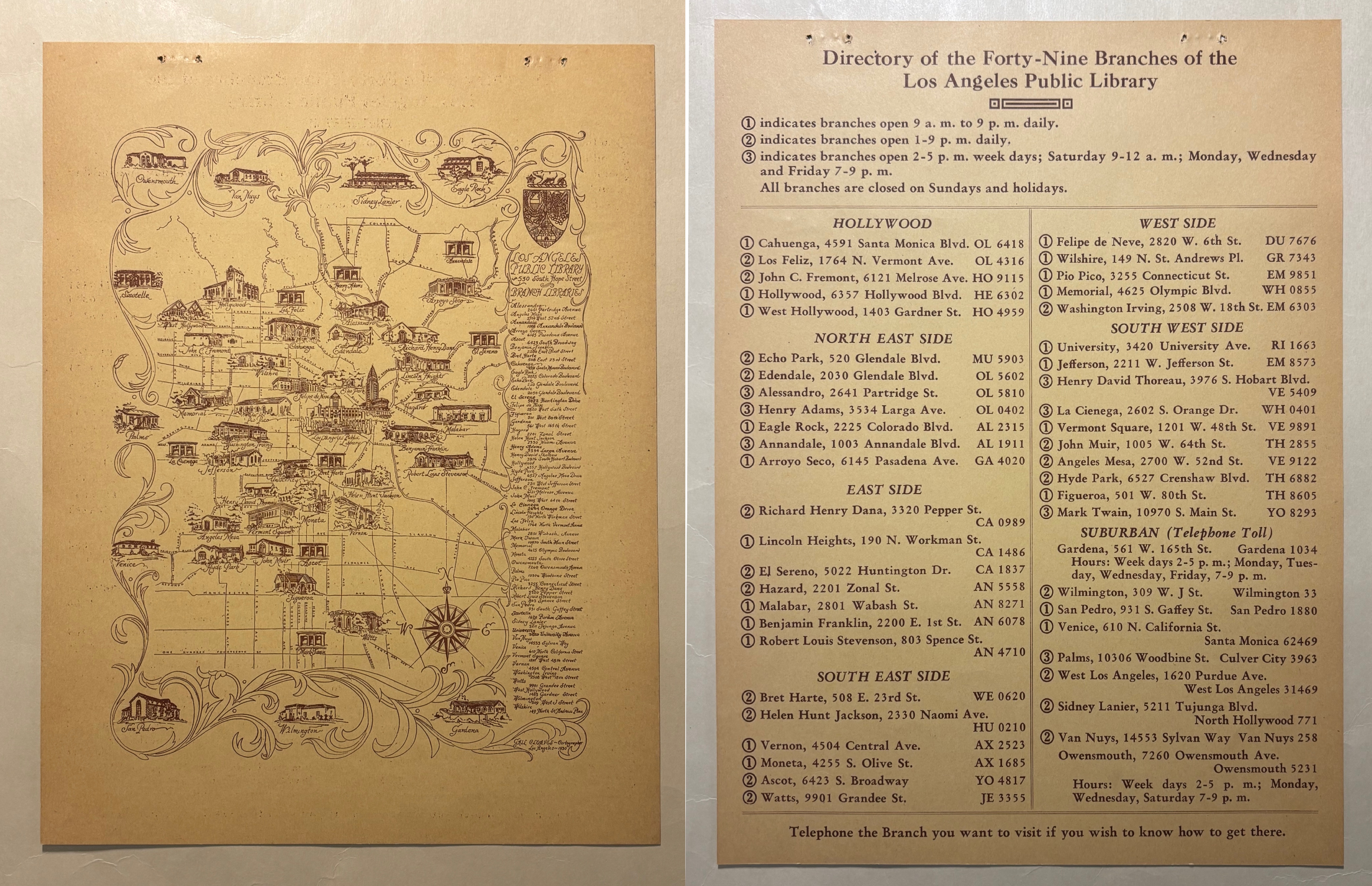
As part of the application process, Cleaves had to submit a proposal to PWAP. It included what can only be described as a draft she made sometime in 1930. The draft depicts "a pictorial presentation of the entire library system in a decorative wall map." Central Library stood as the focal point, with City Hall towering immediately behind. Forty established branches populated a map of Los Angeles, with streets and the Los Angeles River serving as landmarks. Eight branches that had not yet been built were represented by a generic building shaped like a rectangular box with a central doorway and large storefront windows on both sides of the door. Decorative scrollwork framed the entirety of the image. To the right of the map was a list of the branch locations and their addresses. Cleaves chose to crown this list with the library seal Carleton Winslow designed—the same seal that lives on the cornerstone of Central Library, featuring a shield divided into three, with the left half featuring a Bald Eagle (to reflect the United States), while the right half depicted the symbolism of Mexico—an eagle grasping a snake. The bottom of the crest shows a stone tower that alludes to Spain, while seated atop the shield was a bear and a star symbolizing the flag of the California Republic. The size of the draft was not indicated, but meeting minutes indicate that the painting would enlarge what appeared on the draft. When the proposal trickled down to the Municipal Art Commission, the Commission asked for the following changes to the draft: "the seal be removed from its present location and, if used at all, be placed in the lower left hand corner within the inner margin, and be of a size to balance the compass on the right hand side; that the three captions on the right hand border be spaced to correspond with the three buildings on the left hand side." Reading between the lines, the Municipal Art Commission's suggestions for these minor and, frankly, insignificant changes to Cleaves' submission seem to indicate the Commission was throwing its weight around as an official city entity.
The Library Commission meeting minutes show a flurry of correspondence from the Municipal Art Commission in early 1934, urging the Library Commission to approve their finalized design of Cleaves' submission. One can assume that the urgency within the correspondence might be explained by the fact that PWAP would conclude in less than three months.
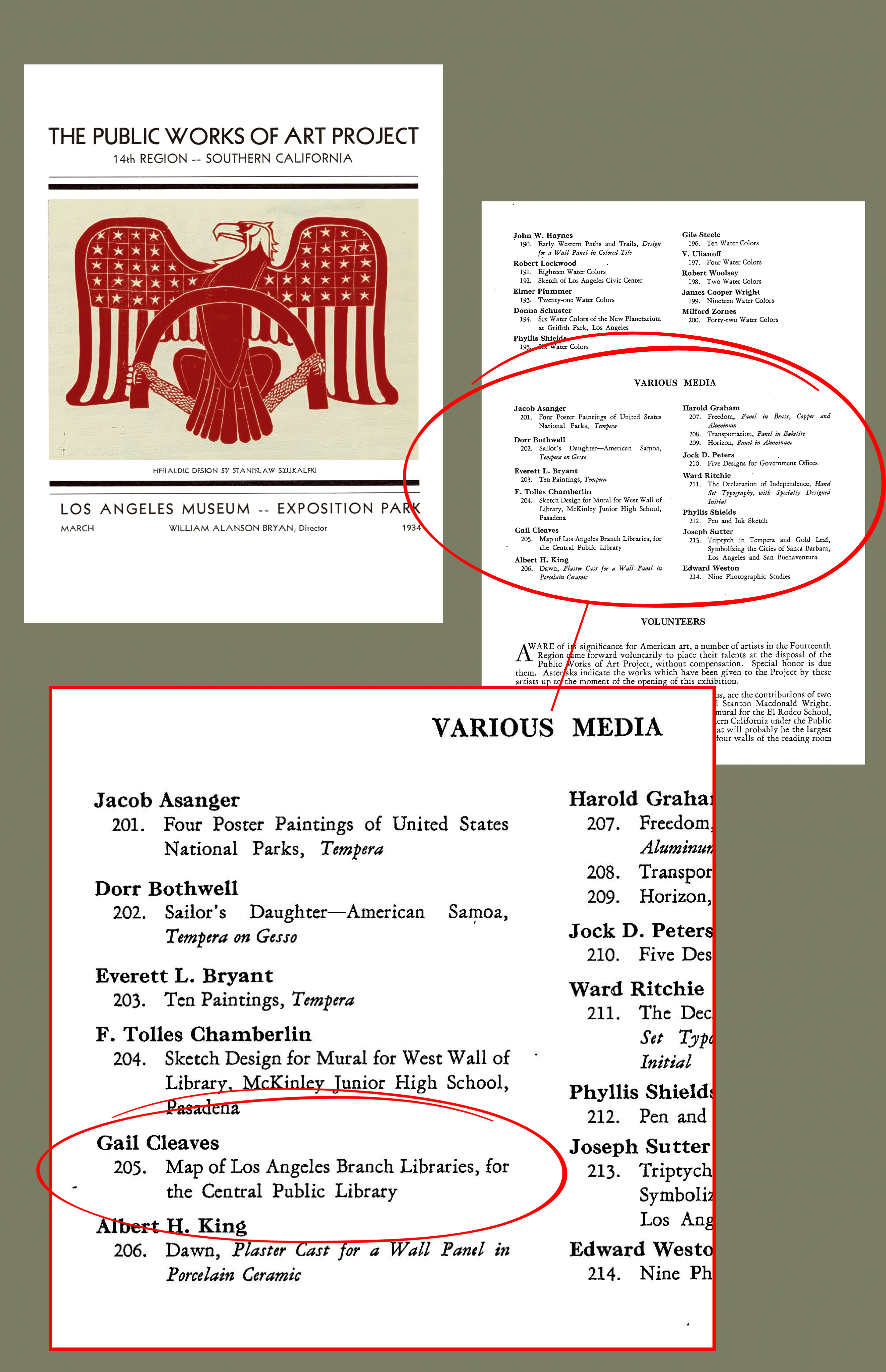
In March 1934, Cleaves' work was included in a two-week-long exhibition of art created in conjunction with the Public Works of Art Project. The exhibition took place at the Los Angeles Museum (Natural History Museum) and was limited to work created for Region 14. Six categories representing mural panels, oil paintings, prints, sculpture, watercolors, and 'various media' were represented. The Cleaves painting appears under 'various media,' though the program does not identify the particular media Cleaves chose to realize her work. The media of other works within the same category are identified (pen and ink, tempera, porcelain, ceramic, etc.); however, making Cleaves' work one of the more enigmatic entries in the exhibition. We do know from Library Commission meeting minutes that the finished painting was oil on canvas, so why the discrepancy? If the painting was unfinished when the program was published, that might explain this discrepancy, or perhaps the organizers were unable to contact Cleaves as the program was coming together. The exhibition appears to have come together in a very short amount of time, and no doubt some corners may have been cut. It's also possible that Cleaves' draft was exhibited, instead of the painting itself, which, in all likelihood, was still being worked on, though this can't be confirmed one way or another.
Library Commission meeting minutes from January 1934 indicated the painting was projected to be "approximately 7 feet by 9 feet." However, the biography of Cleaves released by the News Office of the Los Angeles Public Library states that the final painting was "5 feet by 7 feet." That same press release gives us the only indication of what the final painting looked like: "The colors are gray green with a touch of terra cotta in the tile roofs of the branch libraries, all of which are painted in miniature and given their approximate location. The effect is that of old parchment."
As unappealing as ‘gray-green’ sounds, Cleaves knew what she was doing. A majority of branch exteriors were painted white, beige, or a muted yellow, so when they were depicted, they would have disappeared into a more neutral background. A sage-colored background would have contrasted the buildings nicely and would not have been too jarring to the eye, the way solid black or a primary color would. It might also be reasonable to factor in the cost of paint. Sage green may have been the most economical option to cover a large area at a time when money was tight and, just to reiterate, the library was responsible for purchasing Cleaves’ paints. Ultimately, it's likely that both economic and aesthetic considerations were factors in realizing the final painting.
While the meeting minutes and press release give some idea of the painting's size and color, the exact location of Cleaves' painting is unclear. The painting itself was not mounted in a frame and hung, but was instead adhered directly to the wall, in the same manner as most of the murals throughout Central Library. A communique from the Municipal Art Commission to the Library Commission is the least helpful, indicating that the painting was "installed on the wall in Central Library." Other sources are more generous, and the most consistent description is that the painting was placed in the foyer opposite the Fifth Street entrance. Prior to the painting's completion, one mention in the meeting minutes indicated it was to be placed on the east wall opposite the Fifth Street entrance. Another mention states that it was "placed at the foot of the east branch of the north stairway." Some of my colleagues believe it was on the wall of the alcove to the immediate left of the Fifth Street doors. Unfortunately, as we don't have images showing the painting on display, it could have been in any of these locations.
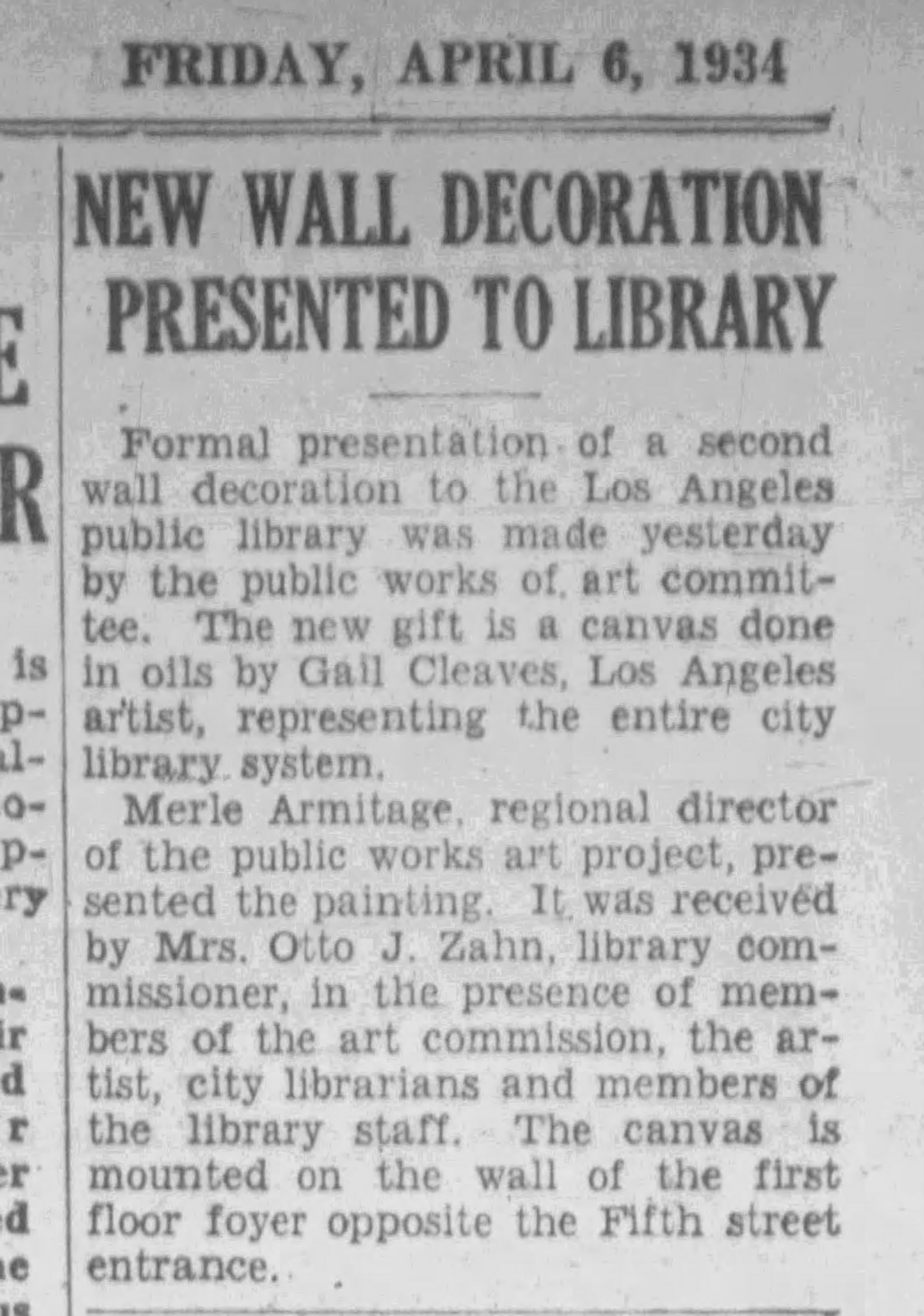
Though details are broad and the painting's final location are unknown, the painting was formally presented at 11 a.m. on April 5, 1934, by Gail Cleaves and Merle Armitage to Library Commission member Frances Harmon Zahn. Members of the Library Commission, the L.A. Art Association, and the Municipal Art Commission were in attendance, as was City Librarian Althea Warren. In a letter to Merle Armitage that was published in California Arts & Architecture Magazine, Warren would write that
"In reviewing an economy year, the public library has certainly cause to count among its blessings, the beauty and embellishment received through the Public Works of Art Project, when no funds for such purposes could possibly be spared from our own meager budget"
Over the years Charles Kassler’s buffalo hunt fresco, which was painted over in 1963, would receive the lion’s share of attention while Cleaves’ painting was forgotten. Kassler’s mural was photographed, publicized and would continue to be discussed for decades largely because of its conspicuousness. Kassler’s work was massive and designed to stand out as it loomed over the walls of the outside garden. Cleaves’ painting, however, was created to blend into the aesthetics of the interiors, achieving its purpose so perfectly that it was ultimately ignored. The only reason contemporary librarians at Central Library are aware of the painting is because of the image of the 1930 draft that lives in the LAPL photo collection. Gail Cleaves original painting, however, has not been seen in more than fifty years.
So What Happened to the Painting?
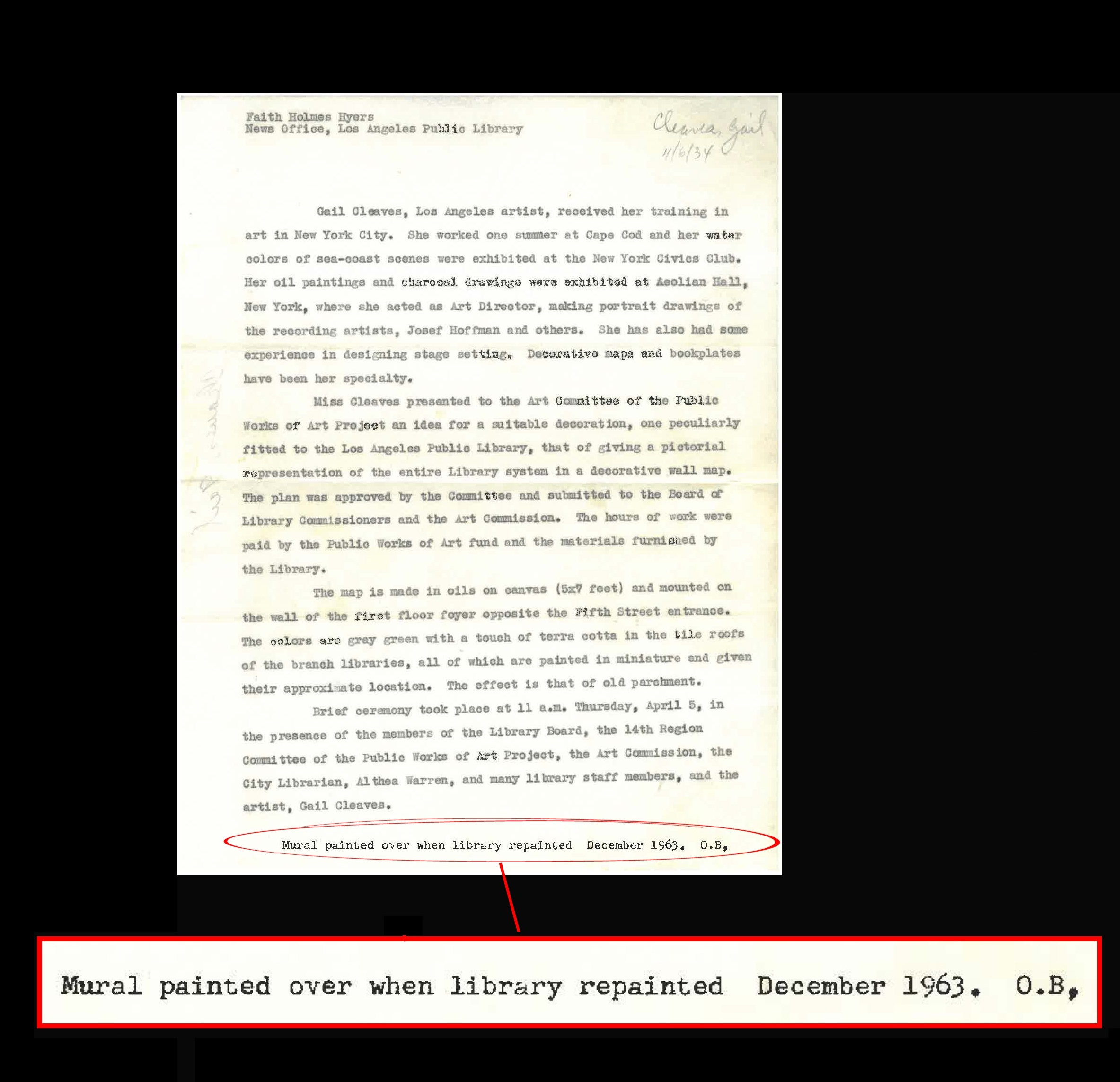
The only indication of what happened to the painting comes from an addendum to the 1934 news office press release. A single typed sentence states the work was "painted over when the library repainted", and includes a date of "December 1963." A pair of what appears to be initials appears after the sentence. It's not clear if this is when the painting was "painted over" or when the notation was made. A search of the Library Commission meeting minutes for November 1963 through February 1964 failed to mention the ultimate fate of Cleaves' painting. It's possible that the artwork is still on a wall under layers of paint.
I'd like to close this essay on an upbeat note and share that I submitted Gail Cleaves and her Los Angeles Public Library Branch Library painting to a UC Berkeley web-based project, The Living New Deal. The Living New Deal website is a project that is attempting to map and document works created during Franklin Roosevelt's New Deal (this includes PWAP) and also includes works that have been lost, like Cleaves painting. Over time, the project has built the most comprehensive database of New Deal public works and artworks, and I'm keeping my eye out for the day that Gail Cleaves and her painting take their place alongside Charles Kassler and his mural.
If nothing else, I'm happy that I was able to shine a light on Gail Cleaves and her lost artwork, though she deserves so much more.
Sincere "Thank Yous" to the amazing librarians: Jim Sherman, Christina Rice, Alice Schock, and Tiffney Sanford, as well as Todd Lerew of the Library Foundation, for their help.