Interview With an Author: Blair Palmer Yoxall


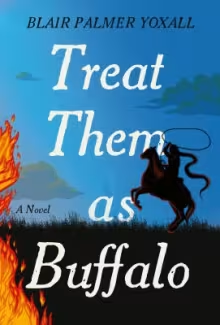
Blair Palmer Yoxall (he/him/his) is an award-winning writer and poet. Blair is a citizen of the Métis Nation of Alberta, and is of Métis and settler parentage. He enjoys fly-fishing in the Alberta Rockies. Treat Them as Buffalo is his debut novel, and he recently talked about it with Daryl Maxwell for the LAPL Blog.
What was your inspiration for Treat Them as Buffalo?
Being a young boy on the Canadian prairies, I loved Westerns. The sublime landscape, the impossible people, the legendary history. It all reminded me of home. And Westerns were the only genre where I was guaranteed to see other Indigenous Peoples represented. But I was always offended by how I saw Indigenous Peoples represented. The sexist, racist, violent tropes and mythologies in Westerns wore me out. What’s more, I couldn’t make sense of the Cowboys versus Indians narrative—in my family, the Indians were Cowboys. For this novel, I wanted to claim Westerns as an Indigenous genre so I could tell my people’s story on the land where my family comes from. This is how I decided I wanted to write a Western/anti-Western.
My whole life, I’ve been blessed to have a good relationship with my mom. But my maternal grandfather never had a healthy relationship with his mother because of residential schooling and other factors, which he lamented at the end of his life. I wanted to write a book where my grandfather and great-grandmother could love each other and be proud of themselves as Métis people. I wanted to write a book where they could save each other from the lived horrors of colonialism. This is how I decided to write an historical novel from a Métis son’s perspective.
Are Niko, Chapan, Nimama, Auntie, or any of the other characters in the novel, inspired by or based on specific individuals?
For better and worse, almost all the characters are partly inspired or informed by real people to different degrees—family, friends, family of friends, ancestors, and their friends all either haunt or homestead in the novel in some way. Even some dogs, cats, and horses are named after animals that were in my life. Often, characters are named after family, villains are informed by people who enraged me, and most of the community members’ names are nods to Métis culture and families. It’s fiction, but I still wanted this novel to be deceptively personal to me as its author.
Same question for Kate McCannon (because I think there may be a story there)?
Kate McCannon is probably the most fictional character in the novel, by which I mean she takes inspiration from everywhere. I needed a John Wayne with brown skin and braided hair for my book, so I looked everywhere John Wayne couldn’t be.
I knew the legend of Kate McCannon was historically plausible because of real-life frontierswomen like Calamity Jane and Annie Oakley, whom I imagine Kate McCannon riding alongside in Buffalo Bill’s Wild West show one day—with legendary Métis warrior Gabriel Dumont too, of course. I also knew the seediness of Kate McCannon’s past was plausible because of women like Madam Dora DuFran, who ran a notorious brothel in Deadwood. However, the biggest Indigenous influence for Kate McCannon was Annie Bannatyne—a Métis woman from the Red River Colony who famously horsewhipped a settler journalist in 1869 for a racist and sexist article he’d published about Métis women in Red River. Honestly, I wouldn’t be surprised if Kate McCannon was there to egg Annie on.
Kate McCannon gets her name from a strange place, too. A Saskatchewan country singer named Colter Wall has an incredible song called "Kate McCannon," which is a murder ballad about a man who shoots his lover after catching her cheating down by the creek. I love the song, but—kind of like how I feel about Westerns generally—I find the trope of murdering a cheating lover to be problematic and offensive. I thought, “What if Kate McCannon doesn’t die and gets her revenge?” Alas, my John Wayne had a name: Kate McCannon.
However, the biggest influence on Kate McCannon was Omar Little from the TV series, The Wire. I wanted a character whose legend could only be matched by her depth of humanity and complexity. I needed a character not just for Niko to look up to, but me too. It felt obvious for me to turn to my favorite fictional character of all time.
How did the novel evolve and change as you wrote and revised it? Are there any characters or scenes that were lost in the process that you wish had made it to the published version?
I started draft zero of Treat Them as Buffalo in October 2019 in Saskatoon, Saskatchewan, and I finished draft zero on April 15, 2020, in Edmonton, Alberta. That draft zero was something like 150,000 words long, which is three times longer than the published novel. Although whole chapters, scenes, characters, and poetic descriptions fell to the editing room floor, the soul of the novel never changed. Everything that ended up on the editing room floor ended up there because that’s where it needed to be.
The only thing that really got lost in the editing process that I wish could find space in the final version is the emotional depth of the discussion about poverty and race between Chapan and Niko in Chapter 8. Although the essence of that conversation is still in the book, it took an angrier tone than in the earliest drafts, which was a much sadder and more detailed discussion about the generational and systematic aspects of poverty. I wasn’t pressured to change this scene—it just kind of changed to fit the story. I think the current scene is better for the novel overall, but the original was poetic and real in a way that deserves to be in another project.
Something unexpected I had to edit out was the word and concept of "lockdown." I started draft zero before the onset of the COVID-19 emergency, so I often described Niko’s isolation in the homestead as a lockdown. When the actual COVID-19 lockdowns happened, I felt like I somehow made it happen by writing about Niko’s lockdown. That was weird.
How familiar were you with the District of Saskatchewan in the late 19th Century, and the North-West Resistance, prior to writing your novel? Did you have to do a bit of research? If so, how long did it take you to do the research and write Treat Them as Buffalo?
I know we were taught about the Resistance in school, but I don’t remember what we learned other than Louis Riel was extremely controversial and misunderstood for a variety of reasons. What I do remember is that we were never taught about the Resistance in the context of the Indian Wars that were happening in the United States around the same time. In hindsight, this bothers me because it not only undermines the gravity of all these conflicts on Indigenous Peoples on Northern Plains, but it also absolves Canada of blame for perpetrating a race-based Indian war against the Métis Nation. By downplaying the severity of the Resistance, Canada has perpetuated a myth that colonization in Canada was gentler than in the United States. If that were true, my Métis family wouldn’t have colonial scars.
Treat Them as Buffalo is born from my Master of Arts thesis in English, for which I did obscene amounts of historical and cultural research. I visited battle sites in Saskatchewan, stayed with extended family for field research near Loon Lake, and read microfiche of old newspapers, contemporary books about the conflict, modern books about the conflict, diary entries, language books, and everything I could find. Even though I’m Métis, our culture has changed since 1885, so I still had to research the Métis Nation’s historical funerary and religious ceremonies, buffalo-hunting politics, community structures, and so forth. My goal for the novel was to present all this historical and cultural research in such a way that it feels familiar—like you already knew all this and my book just validated you for being a smarty-pants.
What was the most interesting or surprising thing that you learned during your research?
I was most startled by how the characters’ historical anxieties about religion, government, climate, community, and war are present again, albeit in new contexts. I think it’s true that history doesn’t repeat, but rhymes. The relatability of anxiety was both comforting and terrifying: it gave me hope for survival, but not for return.
The most surprising thing overall was how scattered the historical record was compared to the mythology of the North-West War. It makes sense in hindsight, but I expected the history to be well documented and cohesive, whereas I uncovered most of the history like a treasure hunt for clues and stories. The fog of war is real. For example, much of the weather data for the region is unavailable during the months of the conflict, a key edition of the Saskatchewan Herald reporting on Louis Riel’s surrender couldn’t be located, and I couldn’t conclusively verify which battles the Canadian Army used their Gatling gun against the Métis Nation. Much of the history I wanted to include to help readers understand the severity of the conflict couldn’t be included because I wasn’t willing to speculate more than I had to.
Your biography says that you enjoy fly-fishing in the Rocky Mountains. Do you have a favorite spot (that you’re willing to share)?
My all-time favorite spots in the heart of the Rockies are just for a small circle of friends and me. But the Bow River immediately southeast of Calgary produces big, strong rainbow and brown trout that fight hard and recover quickly. There are spots in Calgary to fish the Bow River from shore, including downtown, but the Bow is best experienced on a motorless boat with a buddy or guide. But if you’re ever in Waterton Lakes National Park on the Alberta/Montana border, bring your fly rod, buy a license, and hike to one of the alpine lakes to fish. You’ll have an incredible day.
I will say that Alberta’s most valuable waterways in the Rocky Mountains are threatened by the expected expansion of coal mining in Alberta. Our mountain communities deserve good, sustainable jobs, but we also deserve jobs that support our entire community and our Earth. We can’t endanger our waterways, especially when not everyone in Alberta has access to clean water.
You open your Acknowledgments with “Sara Desjarlais and John Palmer, Treat Them as Buffalo is for you.” Can you tell us who they are and a bit about them?
Sara Desjarlais was my great-grandmother, and John Palmer was my maternal grandfather. Before my grandpa passed away, he’d confided in my mom that he resented my great-grandmother for sending him to residential school, which was a type of Indian boarding school in Canada. My grandpa never repaired his relationship with his mother in her lifetime, only coming to understand the impossibility of her circumstances after she’d passed.
I wanted to write a book where my grandpa and his mom got to love each other and save each other from colonization. I wanted a book where grandpa gets his mom and great-grandma gets her son forever. I wanted to write a book I wish they could have read as young people so that they could feel powerful as Indigenous people.
If/when Treat Them as Buffalo is adapted to a film or series, who would your dream cast be?
I would love to see it animated. I think that’s the best way to translate Niko’s boyish narration to the screen, and I think animation would help couch some of the trauma, grief, and violence in the story. Considering how much Niko loves drawing, I also think it would be a cool way to integrate old sketch styles into animation, kind of like how Loving Vincent used Vincent Van Gogh’s painting style to animate the film.
Live action, I would just love to see all the Indigenous characters played by Indigenous actors—Elle-Maija Tailfeathers, Devery Jacobs, and Tantoo Cardinal, I think, would all be incredible talents in a screen production adapted from my book. I also think it would be a great place for up-and-coming Indigenous actors to shine. At the end of the day, I love seeing how my work inspires other artists.
As a debut author, what have you learned during the process of getting your novel published that you would like to share with other writers about this experience?
Expect life to happen. People will pass away; people on your team will have emergencies; people will come and go with little or no warning; people will make mistakes that take time to fix; plans will fall apart; and delays can happen. You have to be resilient and focused.
For other BIPOC debut authors, we have different expectations and pressures put on us, especially when it comes to trauma, resolution, and representing our entire people with our stories. Not everyone will understand what you’re doing, but everyone will have an opinion on it.
What’s currently on your nightstand?
A lot! The books I’m most looking forward to reading are Half-Bads in White Regalia by Cody Caetano, We Survived the Night by Julian Brave Noisecat, and Wolf, Moon, Dog by Thomas Wharton, as well as a poetry collection from one of my professors, Wound Archive by Anna Veprinska, and another poetry collection from the Poet Laureate of Nanaimo, British Columbia, Empties by Neil Surkan. I usually have Archie Comics on my nightstand too, but I guess not right now.
Can you name your top five favorite or most influential authors?
I like to think of my most influential authors as my literary grandparents (plus the crazy uncle). I won’t lie, most of my literary grandparents probably sleep in different rooms and argue a lot at supper.
My first literary grandparents, Ernest Hemingway and Toni Morrison. These are the two writers who made me want to write professionally in late childhood and early adulthood. Hemingway may have influenced my craft most directly, but the politics and poetics of Morrison’s stories are the stories I aspire to tell.
My second literary grandparents are Franz Kafka and Maria Campbell. The horror of Kafka’s macabre imagination has always attracted me like a moth to flame, and Campbell’s raw honesty in illustrating Métis life in Saskatchewan helped me see and understand my family with safety and intimacy.
As for my crazy uncle, Cormac McCarthy has influenced my writing both directly and indirectly. His approach to plot, hope and hopelessness, and grief all resonate in my stories.
What was your favorite book when you were a child?
There were a few books I loved as a kid. I had an illustrated, abridged children’s version of Great Expectations by Charles Dickens that got me hooked on literature, and I remember enjoying The Phantom Tollbooth by Norton Juster and Frindle by Andrew Clements with my friends, too. But I’m a millennial, so obviously I loved the Harry Potter series.
Was there a book you felt you needed to hide from your parents?
My parents supported my reading, so I don’t think I ever had to hide a book from them. I hid some music and borrowed video games from them, though. I was a mature kid, so my parents gave me a lot of freedom with the media I consumed. My parents weren’t artists, so I’m grateful to have had that space and trust to explore my interests.
Is there a book you’ve faked reading?
I guess I’ve faked having read a book for class, and I’ve faked liking books I read, but I don’t think I’ve ever faked the act of reading a book. That said, I did recently learn about the “performative male” trope, so I’m curious how often I was genuinely reading a book in public that made people think I was trying to look cool or something.
Can you name a book you’ve bought for the cover?
I almost bought Yellowface by R.F. Kuang for the title and cover alone. So simple, but so effective.
Is there a book that changed your life?
Halfbreed by Maria Campbell. Halfbreed is a harrowing memoir first published in 1973 about a Métis woman’s upbringing in Saskatchewan and early adulthood in urban Canada. The memoir vividly illustrates both the joy and hardship of Maria’s early life, bringing a human face to the nebulous concepts of colonialism and Métis Indigeneity. Never have I read a book that made me feel so seen as someone who belongs to a complicated but close Métis family with Saskatchewan roots.
Can you name a book for which you are an evangelist (and you think everyone should read)?
The Education of Augie Merasty: A Residential School Memoir by Joseph Auguste Merasty. Indian boarding schools in the United States and Indian residential schools in Canada left major scars on Indigenous children and families already navigating a life interrupted by colonialism. It can be difficult to understand how a school could be a dangerous place, but The Education of Augie Merasty made the event feel like an experience I could understand and empathize with.
Is there a book you would most want to read again for the first time?
I wish I could read the ending of A Farewell to Arms by Ernest Hemingway for the first time again. It was so fitting for a novel about lost hope and disillusionment. The brutally dissatisfying and abrupt ending left a deep wound that hasn’t healed.
What is the last piece of art (music, movies, TV, more traditional art forms) that you’ve experienced or that has impacted you?
I listen to more music than you can imagine—like, more than 200,000 minutes worth of music in 2025, according to my Spotify Wrapped. Because of that, music and poetry hugely influence my writing. Sometimes I like to transliterate songs into prose fiction. Most recently, I drafted a novella using Kendrick Lamar’s Good Kid, M.A.A.D City as the driving inspiration for the piece, turning the whole album into a nostalgic novella about a failed robbery just outside of Calgary, where I grew up.
What is your idea of THE perfect day (where you could go anywhere/meet with anyone)?
Fly-fishing in my secret favorite spot in the Rockies on a calm late-summer day with my dad’s stepdad and my mom’s dad. Just us three with the whole river to ourselves. We’d have egg salad and paprika sandwiches and iced coffee for lunch on the riverbanks, then we’d head back to the camper just before sunset for ribeye steaks and twice-baked potatoes cooked up by my dad for supper. After we finished eating, the four of us would all share a few nice cigars by the campfire with the northern lights dazzling above us until dawn.
Miss you guys.
What is the question that you’re always hoping you’ll be asked, but never have been?
Yes! What’s up with the ending?
What is your answer?
Without spoilers, for me, it was important to end this novel with the most powerful possible image of resistance and retribution. Colonization for the Métis Nation didn’t end when the story ended. For the Métis Nation, 1885 is truly when bad things happened.
What are you working on now?
Currently, I’m a PhD student in English at the University of Calgary, where I’ll be researching and drafting my next novel about Métis experiences in residential schooling. I’m also gradually chipping away at a collection of short fiction (stories and novellas) about young people in Alberta coming-of-age alongside grief, and I completed some poetry and creative nonfiction this year, which I may want to publish someday.
However, my big goal for the summer is to enjoy myself and be proud of my book. This project came at a great personal cost, and I want to appreciate what I’ve accomplished and thank my family and friends for going on this wild ride with me.