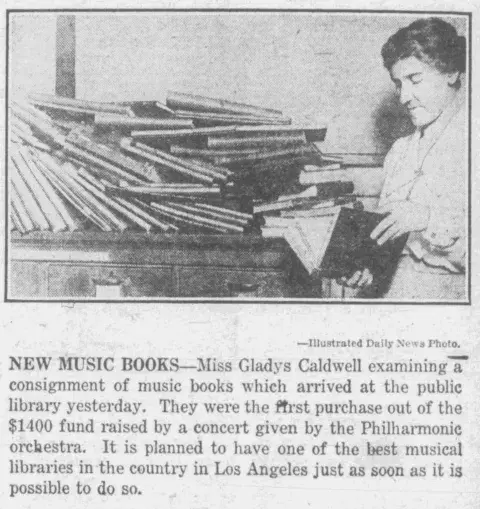
They Once Walked the Halls of Central Library: Gladys Caldwell, Art and Music Librarian


Early twentieth-century Los Angeles was a hotbed of art and music. Painters, sculptors, musicians, craftsmen, writers, photographers, dancers, and the motion picture industry were thriving. Gladys Caldwell was right in the thick of it. She was in charge of the Art and Music Department when the Central Library opened in 1927.
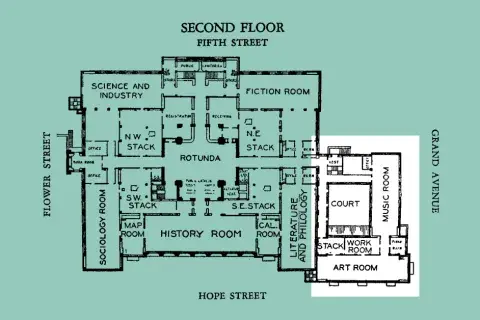
Music Room
![Music Department of the Central Library [1926]](/sites/default/files/styles/embedded_480w/public/media/image/2026-08/photos112846large.jpg.webp?itok=KPgvejCf)
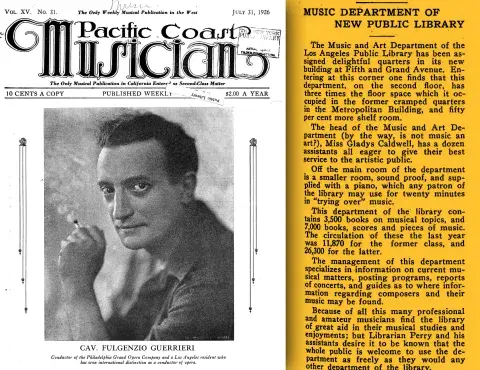
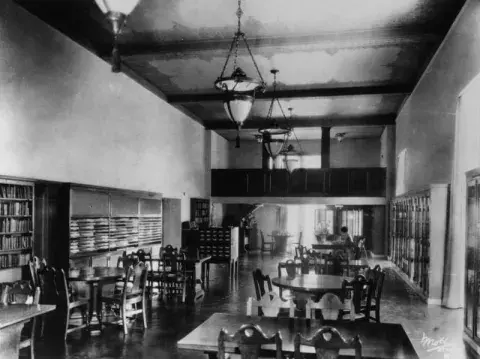
In 1922, Gladys Caldwell, a 1919 graduate of the Los Angeles Public Library Training School, was hired as the head of the Art and Music Department. It's hard to believe today, but the Art and Music Department was split into a Music Room and an Art Room in the new Central Library. The Music Room was accessible via the rotunda or through an entrance from the garden terrace facing Fifth Street. It featured books on music and had labeled drawers filled with music scores that lined one long wall of the room. In the first year of the separate Music Room, there were 52,349 music scores and books checked out, according to the library's annual report. It was also noted that patrons appreciated the accessibility of the materials, which were found on the open shelves (as opposed to being stored in employee-only areas).
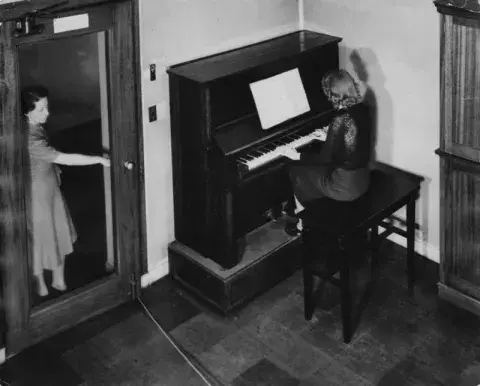
In addition to concerts and musical lectures held in the library's lecture hall, the Music Room was known for its newly built soundproof piano room, which proved incredibly popular. In March 1927, Caldwell reported that 359 people used the piano room. [An apocryphal 1928 story from Los Angeles Times columnist Lee Shippey reported that one of the city's legendary "hermits" enjoyed using the piano room. One day, he told Caldwell he wanted to attend a Hollywood Bowl concert, and she made it happen. He was so appreciative that he brought her cushions he'd purloined from the Bowl as a present for her.]
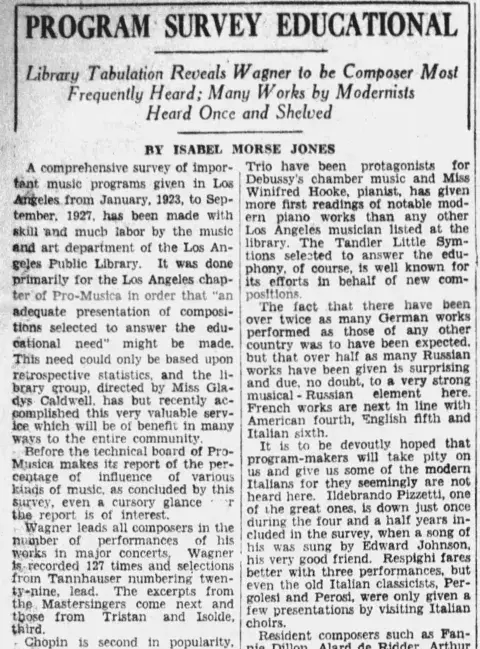
As chairperson of the survey committee of Pro-Musica's Los Angeles chapter, Caldwell and her staff compiled a list of compositions of major music programs in Los Angeles from 1923 to 1927. The intention of the survey was to inform future music programming, study existing programs, and identify neglected composers or genres. The results indicated Richard Wagner's music was very, very popular in Los Angeles from 1923 to 1927. Indeed, Los Angeles was a music town in the early twentieth century. The music collection grew rapidly under Caldwell's tenure, and she often marked important acquisitions in the library's annual journal. These include scores from the English school of lutenist songwriters, added in 1933.
In a paper given at the 1933 American Library Association (ALA) conference, the methods for displaying materials in Central Library's Music Room were described. A seven-tiered magazine rack was repurposed to hold sheet music. It was placed at the entrance of the room with signs reading "Take Home Some Music" or "Music for Home Use." The librarian elaborated, "As a rule we try to put out novelties, Cinderellas that are usually overlooked, or music with a definite popular appeal." Larger collections were advertised via two of the Music Room's 26x30 bulletin boards, which were changed monthly. [Interested in the library's sheet music collection? Check out Songs in the Key of Los Angeles edited by Josh Kun.)
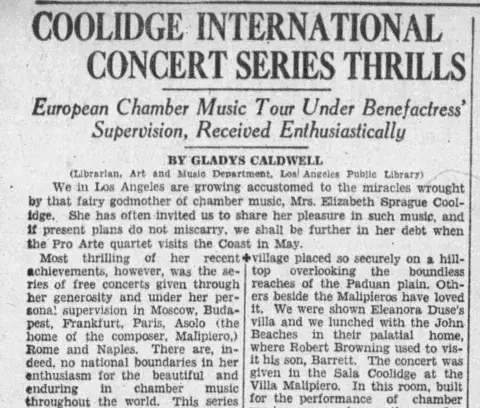
As a young pianist, Caldwell studied with musician (and patron of chamber music) Elizabeth Sprague Coolidge. They remained friendly over the years, and in 1931, Caldwell traveled across Europe with Coolidge to a series of free concerts funded by Coolidge. Caldwell wrote about the trip, including stops in Moscow, Budapest, Frankfurt, Paris, Asolo, Rome, and Naples, for the Los Angeles Times. Sprague also financed concerts at the Los Angeles Public Library, including a collaboration between the library and the Greek Theater, which drew as many as 4,000 people.
The first ten years in the new Central Library building saw the Art and Music Department's circulation jump by 167%, according to the 1936 library annual report. The highest percentage of any other department. This included circulating orchestral scores from the William Andrews Clark Jr. Collection, which the library inherited upon Mr. Clark's death in 1934. Clark was, among other things, the founder of the Los Angeles Philharmonic. (Today, the Los Angeles Public Library has the Orchestral Scores Collection, containing 2000+ scores that can be lent to orchestras in Southern California. Learn more about the library's Orchestration Service here.)
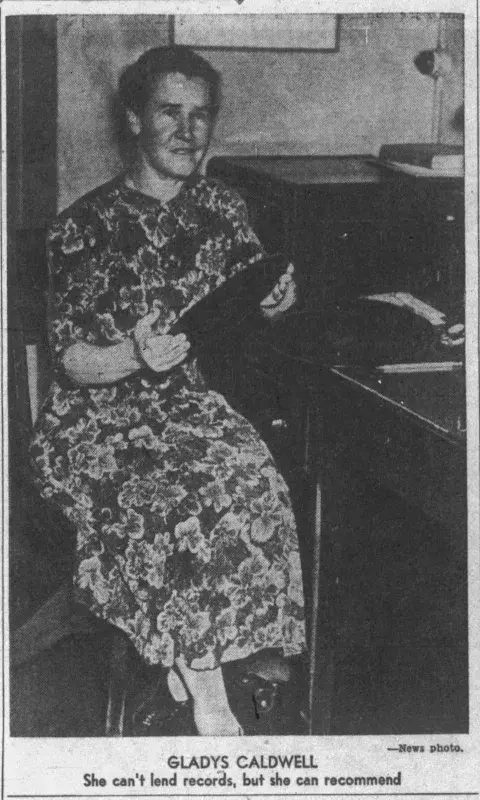
For years, Caldwell had asked to update the library with equipment and materials that would bring it up to speed in terms of listening to phonographs. In 1938, it was noted in the Los Angeles Daily News that a woman named Alice Bluett donated money to the library for a phonograph and approximately 400 "carefully and liberally chosen" records. Another collection of records was donated by Mabel Brousseau in the name of her sister Kate. Combined, the collection made the Los Angeles Public Library one of the best "listening libraries" in the country. A local music company, Birkel-Richardson, helped the library fine-tune the operation through its expertise on amplification. This allowed the library to expand its musical programming with recorded music alongside lectures and live concerts. The crowds for the noon-day record listening events often overflowed onto the patio (Children's Court) and onto the library's lawn. Soon, the Los Angeles Times and Carnegie Corporation also donated records to the collection. Sadly, these record listening events became intermittent in 1943 due to a lack of staff.
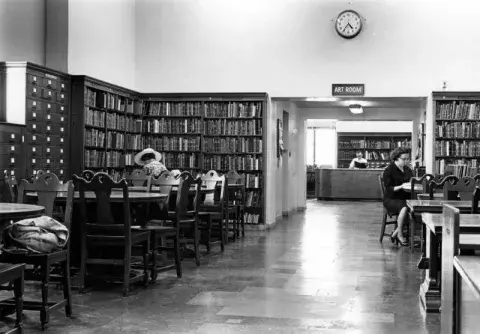
Art Room
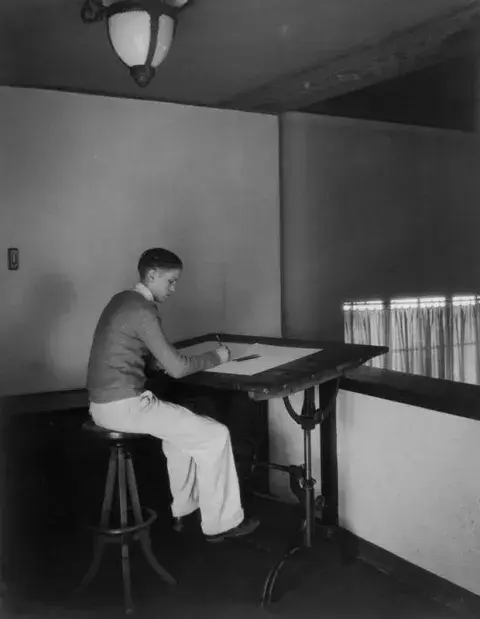
After walking through the Music Room and through a short corridor, you would enter the Art Room. Library annual reports during Central Library's early years acknowledge the growing art reference collection. Several of these collections, including Japanese prints by Hiroshige, as well as etchings, woodcuts, lithographs, and drawings (many by California artists), now reside in Special Collections. Depression-era annual reports noted that the Art Room was busy supplying resources on "every phase of ancient and modern art, supplying books on design, commercial art, home handicraft, and material for art teachers and students."
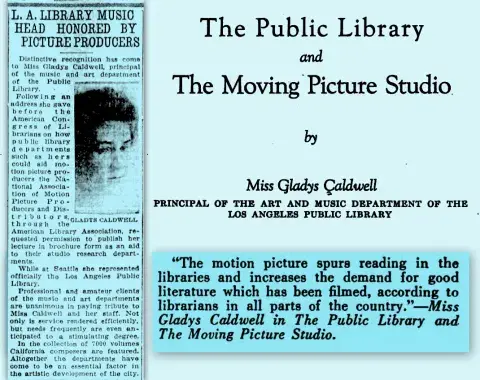
In addition to numerous books and periodicals on art and artists, the library staff conducted extensive research for motion pictures. In July 1925, Gladys Caldwell (or G.C., as she was apparently known to staff) was part of the Los Angeles Public Library staff attending the American Library Association conference in Seattle. Caldwell gave an address at the conference on how her department worked with motion picture studios. It was so well received that the National Association of Motion Picture Producers and Distributors (now the Motion Picture Association) asked ALA to reprint it in booklet form as an aid to its studio research departments. The booklet was called The Public Library and the Moving Picture Studio.
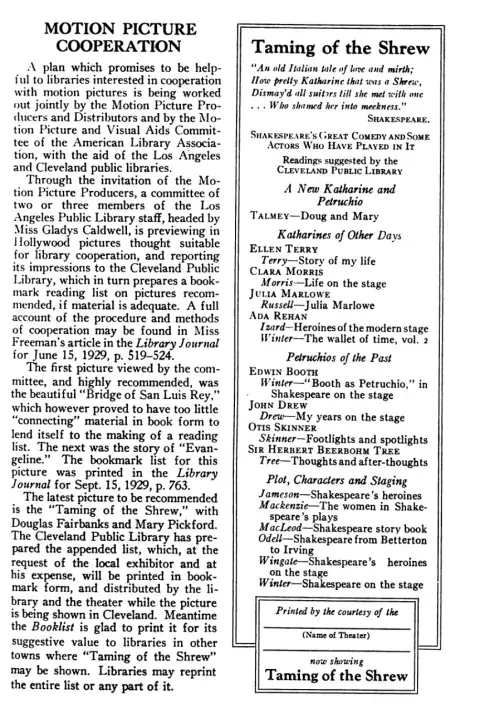
In 1929, the Los Angeles Public Library partnered with the Cleveland Public Library on a motion picture-public library collaboration. Caldwell led a small group of LAPL staffers who, through the generosity of motion picture producers, would preview "Hollywood pictures thought suitable for library cooperation." LAPL would then partner with the Cleveland Public Library to create reading lists for each film's bookmarks as part of the movie's marketing plan. When the movie played in a town with a public library, the motion picture studio would supply local libraries with the bookmark reading list created for that film.
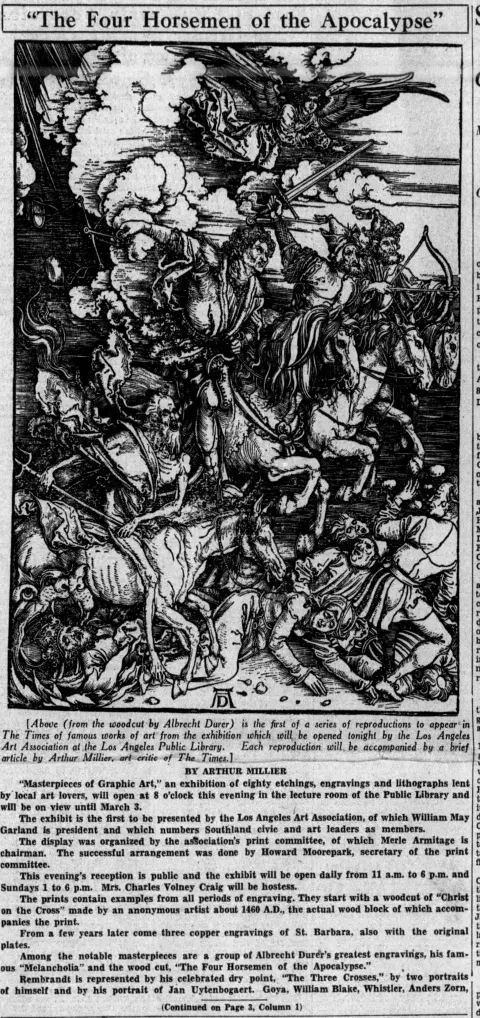
During the 1930s, the Art and Music Department continued to sponsor well-attended evening lectures that featured Caldwell as well as other "prominent leaders in art and music activities in the city." Due to a lack of staff resulting from budgetary constraints during the Depression, it became impossible to maintain a similar pace during the day. Luckily, the Los Angeles Art Association took over the library's exhibit space daily from 11 a.m. to 5 p.m. in 1934. Along with their monthly exhibits, there was also a corresponding radio program on KFAC, and Los Angeles Times art critic Arthur Millier wrote up each of the exhibits. This was a boon for the Art and Music Department and led to increased circulation as people sought resources related to these exhibits.
During her tenure as Art and Music Librarian at the Los Angeles Public Library, Caldwell was instrumental in promoting both art and music librarianship. She was chairperson of the American Library Association's Motion Picture and Visual Aid Round Table and the Art Reference Round Table. In 1941, she became the president of the new Music Library Association chapter in California. Miss Caldwell represented the library all over town during her years at the Los Angeles Public Library, attending club meetings, local concerts, music salons, art galleries, and Hollywood Bowl and Philharmonic events. She retired in the late 1940s and passed away in 1979 at the age of 94.