
Are There Hidden Masonic Symbols on the Los Angeles Central Library? Part 2


In Part 1 of our post, we looked at sculpture on the Library’s exterior as it reflects an overall theme, The Light of Learning. Now we will move to the building’s interior and examine the symbolic motifs contained on the rotunda’s stenciled ceiling and chandelier. Then we will explore a different issue: architect Bertram Goodhue’s use of style references in his library’s interior and exterior design, and parallels in various design projects produced by the Masons. Finally, we will try to draw some conclusions about the possibility of Masonic influence on the library’s art and design. (Note: We are looking only at the original library building from 1926, now called the Goodhue Building, not the new Tom Bradley Wing opened in 1993.)
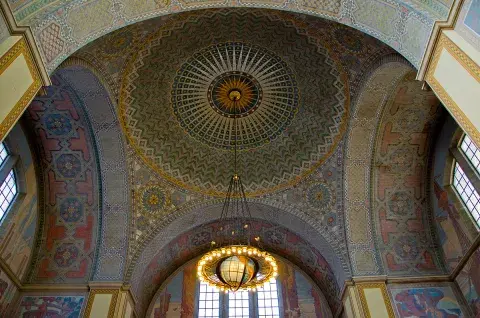
Like its exterior, the original library building’s interior features elements reminiscent of Masonic motifs and symbols. Goodhue centered his library plan on a rotunda that dominates the building’s main floor; a chandelier modeled by Lee Lawrie hangs from the central dome. Connecting it to the ceiling is a chain decorated with a sunburst, a crescent moon, and a group of stars. The celestial reference continues in the dome itself, whose center is painted with a blue canopy covered with golden stars. As mentioned earlier, the combination of a sunburst, a crescent moon, and stars is a basic symbol that appears frequently on the tracing boards kept in Masonic lodges. In addition, those lodges sometimes have their meeting room ceilings painted blue and decorated with stars to symbolize the canopy of heaven. (That may be the reason Masonic lodges are nicknamed Blue Lodges.)
So far in our quest to determine whether Masonic influences had an impact on the design and decoration of the Los Angeles Central Library, we have been examining similarities in the use of symbols. Now we will move over to the question of style. Style means how all the elements in an artwork cohere to create meaning. Sometimes style can be a matter of borrowing from or evoking a historic culture, and that is the case with both our library and much of the visual culture created around Freemasonry. Both reflect the inspiration of ancient Egypt, from direct quotations of motifs and architectural details to the use of shape and space that summon up the drama of historic temples and tombs.
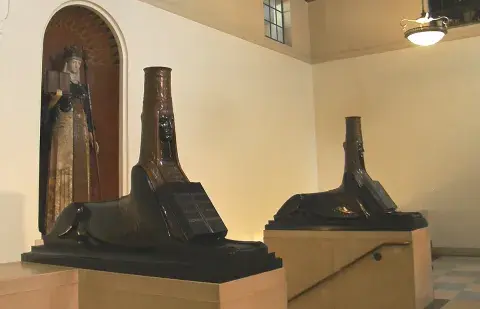
Two particular features of the original Central Library quote elements of ancient Egyptian culture in a way that is immediately recognizable. In the vestibule above the original main staircase, a pair of beautifully crafted black marble-and-bronze sphinxes frames an allegorical sculpture. On the building’s exterior, a striking tiled pyramid (pyramidion) crowns the library’s central tower.
In addition to these details, Goodhue’s design as a whole evokes associations with great ruined temple complexes of ancient Egypt. Such temples were planned with processional approaches that created an impressive vista leading to the entrance. (Queen Hatshepsut’s mortuary temple at Thebes is a famous example.)The Library building’s Flower Street facade captures that aura by combining a dignified sequence of pools and shallow steps leading to a severely simple entrance, itself clearly inspired by a mortuary temple's.
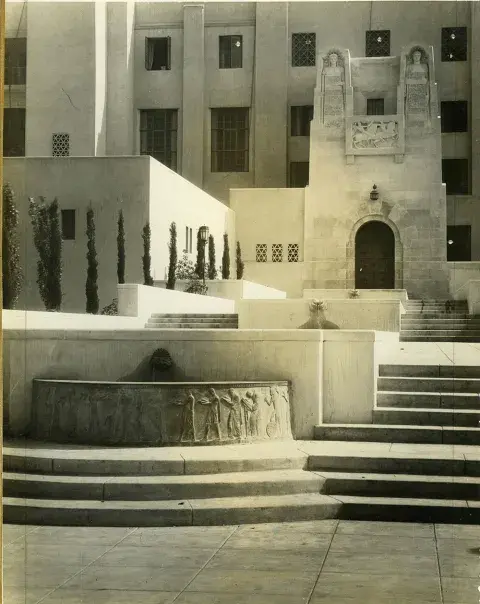
Architectural historians agree that, with the Central Library, Goodhue was attempting to create a truly modern building while embodying echoes of great civilizations past. Turning to the source of ancient Egypt’s austere, monumental temples, pyramids, and sculpture aptly fulfilled both needs.
While Goodhue borrowed from ancient Egyptian culture for aesthetic reasons, the Masons desired a visible link with Egyptian history itself. There is no one "official" history of Freemasonry and its origins. But certain Masonic thinkers, (possibly in the belief that proof of ancient origins confers legitimacy) have chosen to trace their organization’s roots to the great builders of Antiquity. Both the pyramid tombs and the religious myths associated with pan-cosmic Egyptian goddess Isis were a major focus of Albert Pike, whose influential book Morals and Dogma theorized esoteric roots for the branch of Masonry known as Scottish Rite. By the late 18th century, pyramids, sphinxes, and obelisks began to appear in the engravings of Masonic "summons" (calls to appear). By the 19th century, the interiors of certain European Masonic lodges reflected an Egyptian Revival style.
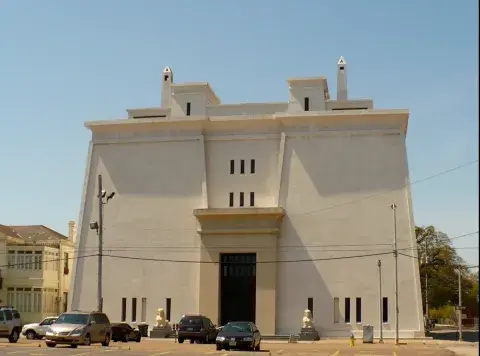
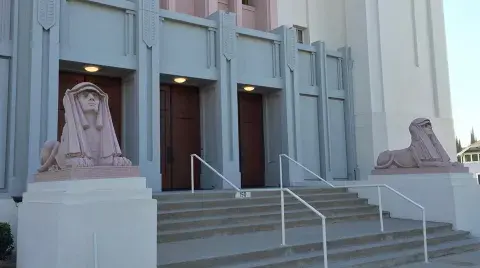
What could be called a Masonic building boom occurred in American cities during the 1920s. Not only lodges, but also temples created by Scottish Rite Masons' and built by the Shriners (a Masonic social and philanthropic organization) occupied prominent spots in dozens of American towns and cities. A number of these buildings contain entire rooms decorated in a lavish version of the Egyptian style, and some have facades that are full-blown Egyptian temple pylons. The front entrances of Scottish Rite temples are frequently framed by sphinxes in much the same way as Lawrie’s bronze and black marble sculptures frame the library’s north staircase.
What Conclusions to Draw?
There is no direct evidence that Masonic symbols were deliberately incorporated into the original library design and decoration. None of the principals involved in planning, funding, or designing the building seems to have been Masons. And other than some personal tie between the Freemasons and those who made decisions about the building’s style and decoration, why would specifically Masonic references have been part of its visual vocabulary? Well, virtually every source that claims ominous cause-and-effect connections between Masonic symbolism and the library’s decoration has the same answer to this question: it’s a conspiracy.
To conspiracy buffs, the ruling class controls us via hidden symbols integrated into every aspect of our visual culture. No logical discussion or proof of these claims is ever offered, other than to demonstrate tenuous connections between art makers and persons of great wealth and influence. In the case of our library, the fact that architect Goodhue and sculptor Lawrie worked together on an unrelated project sponsored by the Rockefeller family—the University of Chicago’s Rockefeller Chapel—is deemed an adequate demonstration of both men’s willingness to take orders from an occult elite bent on world domination.
But if we are reluctant to accept theories of conspiracy, how to account for the many parallels between Masonic themes and symbols and the library’s decorative vocabulary? First, we need to understand that many symbols now associated with Freemasonry have appeared in widely different cultural contexts and evolved a variety of meanings. In other words, just because a sunburst is a symbol used by Masons, not all sunbursts are Masonic symbols. And while there are certain symbols specific to the Masons, like the compass and square, those that overlap with motifs selected by Professor Alexander for the library are fairly universal. Many can be found in sources like the Iconologia, an influential book of allegories, personifications, and symbols compiled by Cesare Ripa, first published in 1593. Other shared motifs, like a blue sky patterned with stars, have been in use since the late Middle Ages, usually to reference the astronomer Ptolemy’s cosmology.
The same observation can be made about Egyptian influences evident both in the library and a variety of Masonic buildings. All were likely impacted by a popular fad that swept Britain and the United States during the 1920s. In 1922, the pharaoh Tutankhamen’s tomb was opened. It turned out to be one of the great archeological finds of modern history and sparked a fascination with ancient Egyptian culture. Bertram Goodhue himself was thrilled to meet the expedition’s leader, Howard Carter, and the Central Library, together with many other buildings of the mid/late 1920s, are exemplars of a whole Egyptian-themed version of Art Deco.
A final thought. We have really been dealing with two questions. First, is hidden Masonic symbolism incorporated into the Goodhue Building’s design and decoration? But equally important and interesting, why do so many library visitors believe that such a connection exists? Is it perhaps because basic compatibility exists between the values of Freemasonry as an historic organization and the humanist philosophy evident in Hartley Burr Alexander’s thematic program for the library?
Freemasonry has a tradition of religious tolerance. Belief in a Supreme Being is required, but adherence to any particular religious faith is not. Jew, Christian, Moslem, Buddhist, Taoist—all are accepted. This conviction that, while religion is a force for good, specific creeds do not matter aligns comfortably with Professor Alexander’s attitudes. Alexander was a professor of philosophy in an era when that field encompassed comparative religion. Alexander himself was an expert in Native American religions. If you examine the totality of his iconographical program for the original Central Library, you find depictions of Christian, Jewish, and Pagan subject matter. On his scrolls of knowledge (Flower Street facade), he lists Zoroaster, Buddha, Confucius, and Mohammed among history’s great thinkers. Even today, many find such resistance to bias and sectarianism dangerous.
Alexander may not have been a Mason, but he probably would have felt comfortable within the organization. Perhaps not so much the clubby social/philanthropic lodges that exist today, more the 18th-century version that offered a secret, protected environment where radical ideas could be floated without fear. Then as now, the Masons stood for religious tolerance and an enlightened humanism. If those values are somehow “hidden” in the Goodhue Building’s art and design, who could complain?
**A final note. One more similarity exists between the Los Angeles Central Library and various Masonic lodges: questions of survival. Throughout the 1960s and 70s, the aging and overcrowded library building was threatened with demolition. Preservationists organized, and our beautifully restored library with its new Tom Bradley Wing resulted. My conversations with helpful Masonic staff members have alerted me to a like danger. Many lovely Art Deco-style Masonic lodges and temples built during the 1920s are now vulnerable to demolition. Membership in the Freemasons has diminished, maintaining older buildings is expensive, and some lodges and temples sit on valuable real estate. Imaginative repurposing could help. It has already happened with the magnificent Millard Sheets-designed Scottish Rite Temple on Wilshire Blvd., which is slated to become a museum.
Please join us for a docent-led tour of the Central Library.
By Kenon Breazeale, LAPL Docent

