Rosalind Franklin

  • Published
  • Updated
English chemist and X-ray crystallographer, Rosalind Elsie Franklin

Rosalind Elsie Franklin (1920-1958) fue una química y cristalógrafa de rayos X inglesa cuya investigación fue fundamental para el descubrimiento de la estructura molecular del ADN, por el cual tres colegas varones del King's College de Londres ganaron el Premio Nobel de Fisiología o Medicina en 1962. El 25 de julio se cumple el centenario de su nacimiento.

Sus colegas masculinos —James Watson, Francis Crick y Maurice Wilkins— utilizaron datos inéditos de difracción de ADN que ella había recopilado sin su autorización para elaborar su modelo de la estructura helicoidal del ADN, por el cual fueron galardonados. El descubrimiento de la estructura del ADN marcó un punto de inflexión en la historia de la ciencia e inauguró la era moderna de la biología.

Franklin no pudo ser nominada al Premio Nobel junto con los tres hombres porque falleció en 1958 de cáncer de ovario, posiblemente a consecuencia de su trabajo con la radiación. El Comité del Nobel no otorgó, y sigue sin otorgar, premios póstumos. James Watson declaró posteriormente en una entrevista que Franklin debería haber recibido el Premio Nobel de Química. Los honores póstumos incluyen la designación de numerosos institutos y edificios académicos, premios, placas y estatuas.
Lectura recomendada


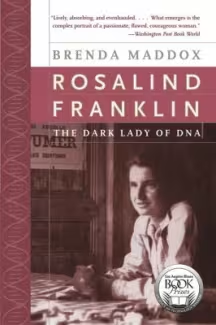
Cover image for Rosalind Franklin: The Dark Lady of DNA

Rosalind Franklin: The Dark Lady of DNA

The sense of the subtitle of this 2003 biography of Rosalind Franklin is captured in a back-cover blurb which states that she was, “airbrushed out of the greatest scientific discovery of the twentieth century.” While the book focuses on the achievement for which she is now best known, this is a complete biography of Franklin from birth until her untimely death.

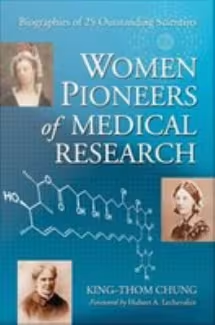
Cover image for Women Pioneers of Medical Research

Women Pioneers of Medical Research

This biographical dictionary of 25 outstanding women scientists in the area of medical research—including the more well-known Florence Nightingale and Madame Marie Sklodowska Curie—provides on each figure a general introduction, together with information on her childhood, her education and family background, her importance within her field, and persons and events that affected her life and career.

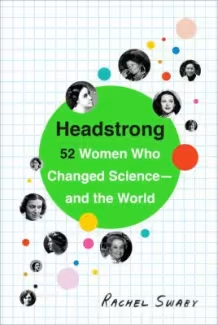
Cover image for Headstrong: 52 Women Who Changed Science - And the World

Headstrong: 52 Women Who Changed Science - And the World

This collection provides brief overviews of women scientists grouped together under medicine, biology and the environment, genetics and development, physics, earth and stars, math and technology and invention. Less a formal biographical dictionary than a popular reader for those interested in women’s contributions to science around the world throughout history or as an inspiration to future research

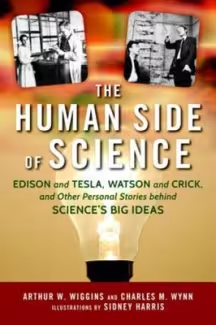
Cover image for The Human Side of Science

The Human Side of Science

This popular look behind the scenes of science and scientists includes humorous cartoons by Sidney Harris. The book focuses on the personalities and conflicts of great scientists to reveal the “human side” of scientific research and discovery.

Cover image for Kid Scientists: True Tales of Childhood From Science Superstars

Kid Scientists: True Tales of Childhood From Science Superstars

Intended for readers ages 7-12 years old and part of the Kid Legends series, this book features 16 profiles of famous scientists during their childhood years, with whimsical color illustrations. The book provides a brief bibliography for further reading on each scientist, as well as a helpful index. The series is intended to show new readers that their heroes were once just like them.

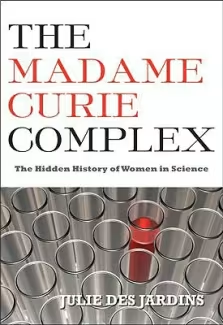
Cover image for The Madame Curie Complex: The Hidden History of Women in Science

The Madame Curie Complex: The Hidden History of Women in Science

Published by The Feminist Press at CUNY, this book sets out to “[dismantle] the myth of the lone male genius.” The book examines why and how it is that the history of women in science has been hidden, and seeks to rectify it with anecdotes and profiles of modern women scientists. A blurb for the book summarizes, “They often asked different questions, used different methods, and came up with different, groundbreaking explanations for phenomena in the natural world.”

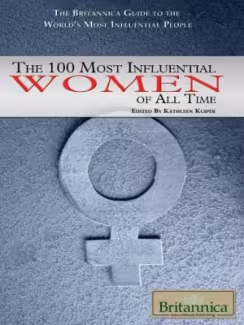
Cover image for The 100 Most Influential Women of All Time

The 100 Most Influential Women of All Time

Part of the Britannica Guide to the World's Most Influential People series, this book provides chronologically arranged, brief profiles on the most influential women from around the world throughout history. Thus is Rosalind Franklin ranked alongside queens and empresses, first ladies and prime ministers.

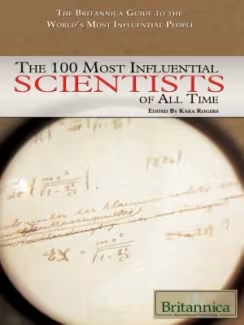
Cover image for The 100 Most Influential Scientists of all Time

The 100 Most Influential Scientists of all Time

Also a part of the same Britannica series, this book provides profiles of the most influential scientists throughout history from around the world. Rosalind Franklin appears beside eight other women, and together with profiles of James Watson and Francis Crick, who won the Nobel Prize in 1962 based in large part on her research.