The Industry In Our Backyard

  • Published
  • Updated
A close-up shot is lined up by the director and cameraman during a Maverick shoot on the Warner Bros. lot in Burbank, [1961]. Valley Times Collection

In January 1947, KTLA Channel 5, Los Angeles's first commercial television station, aired its first broadcast, and the Herald Express newspaper was there to report the milestone event. Since then, despite its phenomenal growth into one of the most successful and influential industries in the world, television continued to remain local news in Los Angeles, and local papers like the Herald and the Valley Times covered its productions & workforce on back lots, sound stages, location shoots and even sidewalks.

Camera operators, sound technicians, and even the animal trainers shared pages with the stars, accompanied by captions that detailed the process of producing a show, as well as promoting the new additions to the prime-time lineup. Reporters were granted access to rehearsals, press conferences, location shoots and newsrooms, and their readers were treated to an insider's view of their favorite programs on the set, and a glimpse into the advanced technology that became more sophisticated with each passing year.

Compiled from the archives of the Herald Examiner and the Valley Times collections, the following images provide a look at the mutually beneficial relationship between the industry that employed millions and entertained the world, and the city, with its temperate climate and proximity to mountains, beaches, suburbs and urban locations, that helped it thrive.
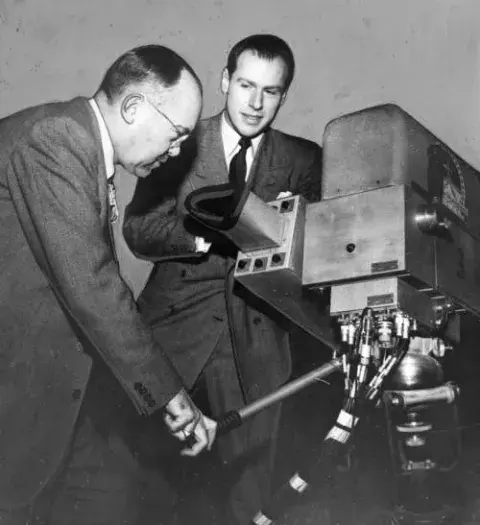
Hilton Tupman and Klaus Landsberg look at a TV camera
Hilton Tupman and Klaus Landsberg look at a TV camera. Photograph dated January 24, 1947. Valley Times Collection.
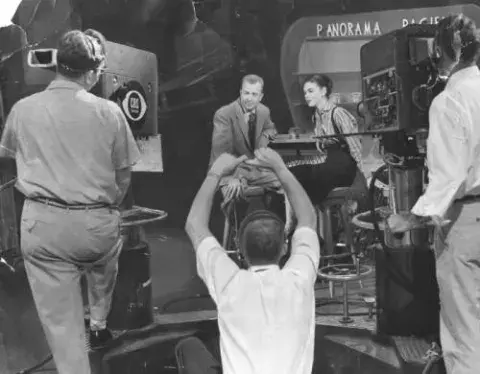
Red Rowe, host of Panorama Pacific, gets a signal from KNXT stage manager Buddy Morrison
Buddy Morrison, KNXT stage manager, gives it to Emcee Red Rowe of the "Panorama Pacific" show because time is running out in his interview of Singer Joanne Gilbert. Photograph dated October 15, 1955. Herald Examiner Collection.
March 23, 1953, in the Los Angeles Federal Building, with KECA-TV crew and Herald Express reporters in attendance
The House Un-American Activities Committee opened a new Communist infiltration hearing on March 23, 1953, in the Los Angeles Federal Building, with KECA-TV crew and Herald Express reporters in attendance. Herald Examiner Collection.
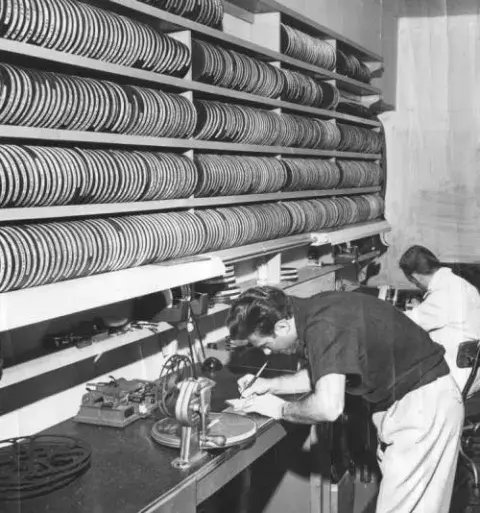
The film editing department at ABC Television Center where reels of commercials are spliced into programs by the station editor
This department, which the center claims is best such equipped in L.A., handles about 100,000 feet of film per week. They try to keep this room as dust proof as possible, for obvious reasons. Photograph dated December 13, 1952. Herald Examiner Collection.
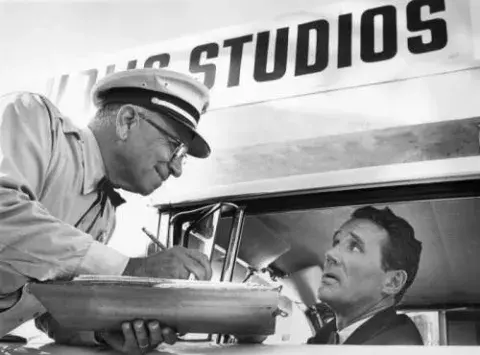
Republic Studios guard Leo Lotito greets actor Howard Duff as he arrives for work.
Republic Studios guard Leo Lotito greets actor Howard Duff as he arrives for work. Photograph dated October 12, 1960. Valley Times Collection.
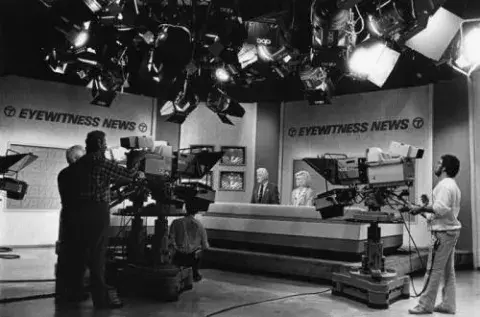
Anchors Jerry Dunphy and Christine Lund on the set of the KABC Channel 7 Eyewitness News
Anchors Jerry Dunphy and Christine Lund on the set of the KABC Channel 7 Eyewitness News. Photograph dated June 2, 1985. Herald Examiner Collection.
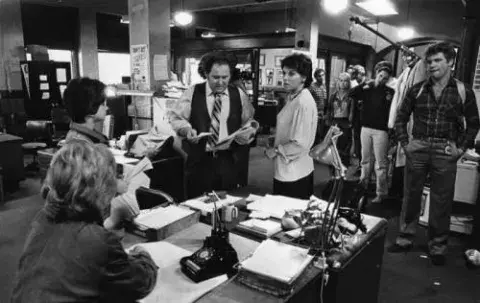
Actress Tyne Daly waits with costars for the director to call places
Pictured are cast members Sharon Gless (with back to camera), Al Waxman, in tie, Tyne Daly and Martin Kove, right, on the set of the TV series 'Cagney & Lacey.' The other persons pictured are unidentified production crew members. Photograph dated 1982. Herald Examiner Collection.
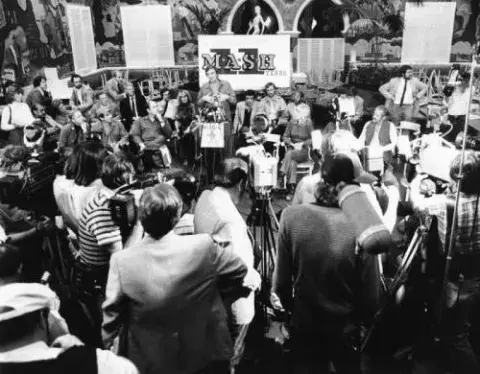
Alan Alda, at the podium, addresses production crew, reporters and guests at the wrap party at 20th Century Fox studios
    
Alan Alda speaks before reporters at the M.A.S.H. series wrap party. Seated from left are cast members William Christopher (hand on chin), Jamie Farr, David Ogden Stiers, Alda, Loretta Swit and Mike Farrell (vest). The immensely popular satire ran 11 years - almost three times longer than the Korean conflict that provided its setting. Over the course of 251 episodes, the series garnered 99 Emmy award nominations and played to an estimated 224 million people. Photograph dated January 14, 1983. Herald Examiner Collection.